Author name: fundyantra.com

Fundspeak

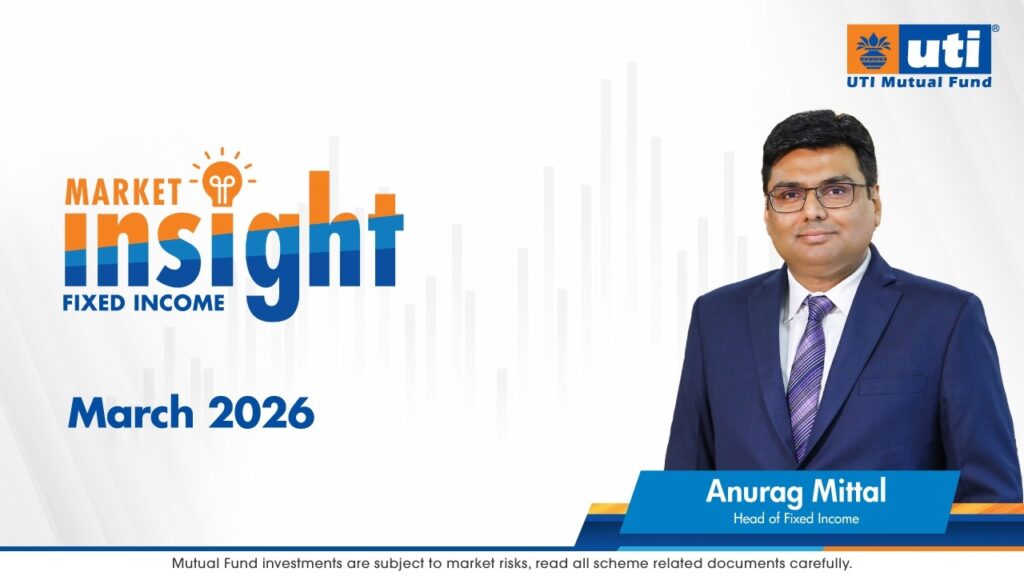
Stable Rates, Tactical Duration, and Credit Selectivity in Fixed Income

Summary: As highlighted by Anurag Mittal, Head of Fixed Income UTI Mutual Fund (10 March 2026), RBI’s prolonged pause and ample liquidity support fixed income stability. Opportunities lie in 2–5 year bonds and selective credit, while investors should align duration strategies with time horizons amid a steady rate environment. Key Takeaways Fundyantra Insights In a range-bound rate cycle, disciplined carry and credit selection may outperform aggressive duration calls. Mutual fund investments are subject to market risks. Read all scheme-related documents carefully.

, ,

Stable Rates, Tactical Duration, and Credit Selectivity in Fixed Income Read Post »

Fundspeak

Global Liquidity, AI Euphoria, and India’s Relative Reset

Summary Rising macro fragilities and valuation excesses are shaping an increasingly asymmetric global market environment. A potential spike in crude above $120 could materially widen India’s current account deficit, triggering currency and inflation pressures despite buffers from services exports. Globally, unprecedented AI capex and concentrated market leadership have driven valuations to extremes, with a narrow set of companies dominating earnings expectations and index weights. This raises vulnerability to earnings disappointments and multiple compression, particularly in US equities where risk-reward appears stretched. India, meanwhile, has underperformed amid elevated valuations and reduced index weight, though pockets of opportunity are emerging as SMID excesses correct and large caps become relatively attractive. The IT sector reflects this transition, caught between cyclical stagnation and structural AI disruption. Key Takeaways Key Takeaways Periods of extreme narrative dominance often precede dispersion—future returns may favor neglected segments over consensus winners. Mutual fund investments are subject to market risks. Read all scheme-related documents carefully.
Global Liquidity, AI Euphoria, and India’s Relative Reset Read Post »

Fundspeak

Monthly Market Outlook (March 2026) by Prateek Agrawal

Summary Artificial Intelligence (AI) is expected to gradually influence Indian businesses, particularly the IT services sector. While AI may automate lower-end coding tasks and slow hiring, complex services such as system integration remain difficult to fully automate. This could lead to stable margins but moderate revenue growth due to pricing pressure and productivity gains. Despite concerns around IT employment and housing demand in tech hubs, India’s diversified economy remains resilient. Manufacturing may benefit from AI-driven efficiency gains, while data centers and digital infrastructure could emerge as new growth areas Global Economy Global investor sentiment has shifted toward markets leading in AI innovation, particularly the US and China. This reallocation of capital away from other markets contributed to India’s recent relative underperformance. Domestic Economy The broader economic impact of AI is expected to remain manageable, with India continuing to grow at over 6.5%. Productivity improvements from AI could support manufacturing growth, while expanding trade agreements and greater labor mobility may help strengthen goods exports. Earnings Growth and Valuations Indian equities faced pressure due to a temporary slowdown in earnings growth and high starting valuations. However, earnings momentum has improved in recent quarters, and relative valuations have corrected following market underperformance. Flows and Liquidity Foreign portfolio investors shifted allocations toward AI-driven markets, while passive flows reduced exposure as India underperformed. With valuations correcting and the currency stabilizing, these flows could gradually turn supportive Closing View Recent market weakness appears driven more by global capital shifts than structural issues. With improving earnings, corrected valuations, and easing volatility after mid-March, the outlook for Indian equities may become more constructive in the coming months. Mutual fund investments are subject to market risks. Read all scheme-related documents carefully.
Monthly Market Outlook (March 2026) by Prateek Agrawal Read Post »

Fundspeak

Market Insight Equity – February 2026 | UTI Mutual Fund

Summary: This summary is based on the UTI Mutual Fund “Equity Market Insight – February 2026” webinar featuring Vetri Subramanyam (MD & CEO, UTI AMC) and Karthik Lakshmanan (Fund Manager, UTI Large Cap Fund). The discussion covered global macroeconomic shifts, trade developments affecting India, fiscal policy outlook, and implications for equity markets. Global and Macroeconomic Drivers Global Debt Shift Toward Governments A major macro trend over the last two decades is the sharp rise in government debt. Prior to the 2008 Global Financial Crisis, debt expansion was largely driven by households and corporations. However, since the crisis, governments have taken on significantly more debt to support economic growth and stabilize economies. This has resulted in higher interest payment burdens for governments, especially in developed economies. With both debt levels and interest rates rising, interest payments as a percentage of GDP have increased sharply across countries. This reduces fiscal flexibility, leaving governments with less room for growth-oriented spending. Emerging Markets vs US Performance Emerging markets have outperformed the US in the past year while the US dollar has weakened. Although historically a weaker dollar tends to support emerging market performance, the relationship is correlational rather than causal. Market performance ultimately depends on multiple factors, with corporate earnings growth and valuations being the most important drivers. Currency movements alone cannot explain sustained equity market performance. Global Trade Dynamics and India’s Position Shift from Multilateral to Bilateral Trade The global trade environment has shifted away from the multilateral framework (WTO-driven system) that dominated since the 1990s. Countries are increasingly relying on bilateral trade agreements. India has actively pursued several such agreements in recent years with partners including: The India–EU trade agreement is particularly significant because the EU is India’s largest trading partner. Currently, India’s share of EU imports remains relatively small compared to China. The agreement could help Indian exporters gain market share, though European exporters will also gain greater access to the Indian market. India–US Trade Relations The earlier trade tensions with the US around reciprocal tariffs and Russian crude purchases have largely been resolved. The current agreement effectively restores tariff conditions similar to those that existed in April 2025. India does not gain a major tariff advantage relative to peers, but it also avoids a competitive disadvantage. Given the US’s economic and geopolitical importance, simply moving away from a trade stalemate is considered a positive outcome for India India’s Fiscal Policy and Growth Outlook Fiscal Consolidation with Continued Capex The recent Union Budget reflects a balanced approach: The period of aggressive fiscal tightening appears largely behind us, and the current fiscal stance remains supportive of economic growth. Maintaining infrastructure investment while improving fiscal discipline provides long-term growth support without significantly weakening public finances. Implications for Equity Markets Key Structural Factors to Watch Several structural factors will influence equity markets going forward: Investment Perspective For investors, the key takeaway emphasized in the session is that short-term news flow should not drive investment decisions. Markets will continue to face daily volatility due to geopolitical and macro developments. However, long-term outcomes are primarily determined by corporate earnings growth and valuations, not by short-term macro headlines. Maintaining a disciplined investment approach aligned with financial goals remains the most important strategy for equity investors. Mutual fund investments are subject to market risks. Read all scheme-related documents carefully.
, ,

Market Insight Equity – February 2026 | UTI Mutual Fund Read Post »

Fundspeak

Market Outlook for February 2026 by Mr. Nilesh Shah | Kotak Mutual Fund

Summary Global growth is expected to moderate in 2026 despite rising fiscal deficits across major economies. While central banks have maintained accommodative policies in recent years, their policy flexibility may narrow going forward as debt burdens rise. Rising unemployment, flattening global consumption, and potential unwinding of the yen carry trade present new macro risks. However, India remains among the faster-growing large economies alongside select Asian peers. Domestically, the Union Budget continues the government’s long-term strategy of infrastructure and manufacturing expansion while gradually improving fiscal discipline. Increased capital expenditure and structural policy reforms could support India’s medium-term growth trajectory if execution remains strong. Global Macro Environment Global growth is expected to slow in 2026 relative to both last year and long-term averages, even as fiscal deficits remain elevated. Central banks pursued relatively easy monetary policy during 2024–2025, but their room for further easing may narrow due to growing debt burdens and inflation considerations. At the same time: These factors create a backdrop of elevated market confidence despite weakening macro indicators. Yen Carry Trade Risk Japanese 10-year bond yields have reached multi-decade highs. For decades, Japan served as a major provider of global liquidity through the yen carry trade, where investors borrowed cheaply in yen to invest in higher-yielding assets globally. If rising Japanese yields trigger unwinding of these trades: However, India’s equity and bond markets appear to have limited exposure to yen carry trade flows, suggesting the impact may be relatively modest. China: Growth with Overcapacity China has demonstrated extraordinary industrial expansion, particularly in electric vehicles and power infrastructure. Key highlights: However, rapid capacity creation has led to declining capacity utilization and falling private investment. To counter this slowdown: Despite large-scale economic growth, Chinese equity markets have historically been volatile, experiencing multiple cycles of sharp gains and declines. A potential correction in Chinese markets could redirect capital flows toward India. United States: Growth Driven by AI The US economy has seen strong growth supported by domestic consumption and massive investments in artificial intelligence infrastructure. Technology companies including Amazon, Microsoft, Google, Meta, and Oracle are investing heavily in hyperscale data centers. These investments are estimated to contribute roughly 0.5% incremental GDP growth to the US economy. Since the pandemic: However, this growth has been accompanied by rising debt levels. Rising Debt Risks in the US Debt intensity in the US economy has increased significantly, meaning more borrowing is required to generate the same level of economic output. Key concerns include: Additionally, labour market data has seen repeated downward revisions, with employment figures revised lower by roughly 600,000 jobs over the past year. Income inequality has also widened significantly, with consumption increasingly concentrated among the top 10% of households. Dollar and Global Capital Flows The US dollar index has weakened significantly since early 2025. A weaker dollar, combined with declining US equity market dominance, could trigger global capital reallocation. Notable developments include: These dynamics may encourage global investors to diversify away from US assets. India Budget: Long-Term Structural Focus The Union Budget continued the government’s long-term economic strategy. Earlier budgets focused on: The latest budget increasingly emphasizes the services sector and future industries. Key positives include: Higher capital spending supports long-term productivity and economic growth. Policy Changes and Concerns Some policy measures generated debate: While some tax policies were viewed as inconsistent with earlier expectations, other reforms—including safe harbor provisions for global capability centers and improved buyback taxation rules—were seen as constructive. Execution: The Key Variable The effectiveness of several initiatives depends heavily on execution. Projects such as infrastructure funds, railway corridors, debt market reforms, and infrastructure guarantee schemes will require timely implementation to deliver intended benefits. Historically, certain financial market reforms—such as interest rate futures and credit default swaps—have struggled due to limited market adoption. Indian Economic Outlook The domestic economic outlook remains broadly positive. Government policy has supported consumption by directing financial support across several groups: In addition, the upcoming pay commission could inject roughly ₹3 lakh crore annually into the economy through salary and pension revisions, potentially supporting consumption growth. Risks Key risks to the outlook include: Opportunities India remains structurally well positioned due to: If global investors diversify away from US assets and China faces cyclical corrections, India could benefit from increased capital inflows. FundYantra View The global macro environment is entering a phase of slower growth but higher fiscal expansion, creating potential volatility across asset classes. India’s relative macro stability, improved public investment quality, and structural growth trajectory position it favorably within emerging markets. However, execution of policy initiatives and sustained capital inflows will remain critical determinants of market performance. Mutual fund investments are subject to market risks. Read all scheme-related documents carefully.

, ,

Market Outlook for February 2026 by Mr. Nilesh Shah | Kotak Mutual Fund Read Post »

Fundspeak

Market Insight Fixed Income- February 2026 | UTI Mutual Fund

Summary: Global economic activity remains in expansionary territory, with improving PMI trends and strong services sector momentum across major economies. Commodity markets have rallied sharply due to strong demand and geopolitical tensions, while food inflation continues to moderate. In India, the RBI maintained policy rates at 5.25% with a neutral stance, while slightly revising inflation projections upward due to base effects. Growth expectations have improved modestly, supported by new trade agreements and improving global demand. Overall, the macro environment suggests stable growth, manageable inflation, and supportive global demand, though liquidity conditions and bond yields remain areas to watch. Global Growth Trends Global economic activity remains resilient. Manufacturing and services PMIs improved in January after a temporary slowdown in November and December, indicating a renewed expansion in global activity. Key highlights: Economic surprise indices in the US and Eurozone also indicate that economic data continues to outperform expectations. Commodity Markets Commodities saw a broad-based rally, with January recording one of the strongest increases in the past 25 years. Drivers included: Precious metals such as gold and silver surged as tensions emerged between the US and European nations regarding Greenland and concerns over potential reductions in US dollar reserves. Industrial metals like copper and aluminium remain in short supply due to rising demand from AI, technology infrastructure, and electrification trends. Energy Markets Energy prices also moved higher due to geopolitical and weather-related factors. Key drivers included: These factors pushed up both oil and natural gas prices, contributing to the broader commodity rally. Food Inflation While commodity prices rose, global food prices continued to decline. The UN Food Price Index fell for the fifth consecutive month, with declines in: These declines offset price increases in cereals and vegetable oils. For India, this trend is positive since food inflation plays a significant role in overall CPI dynamics. Global Bond Markets Bond yields moved higher across most developed markets. The rise was driven primarily by Japan’s long-term bond yields, which increased after the new Japanese government proposed tax cuts on food items, raising concerns about fiscal stability. Because the Japanese yen is widely used in global carry trades, movements in Japanese bond yields influenced bond markets globally, pushing up yields in the US and the UK. Emerging markets showed mixed trends: India Monetary Policy The RBI Monetary Policy Committee (MPC) kept policy rates unchanged at 5.25%, maintaining a neutral policy stance. Voting details: One member suggested shifting toward an accommodative stance. The RBI’s approach indicates a preference to monitor inflation dynamics before considering further policy moves. Inflation Outlook The RBI marginally revised its inflation forecasts upward. Revisions include: The increase is largely attributed to base effects, as inflation was unusually low in the previous year. Despite the revision, inflation remains close to the RBI’s 4% target, suggesting the central bank remains comfortable with the current trajectory. CPI Basket Revision A new CPI series will be introduced based on the 2024 Household Consumer Expenditure Survey. Expected changes include: Because of these changes, the RBI will provide full-year inflation projections in April after assessing the new CPI structure. Growth Outlook India’s growth outlook has improved modestly. Key developments supporting growth include: These agreements create a larger integrated trade network for India and are expected to support economic activity. The RBI revised its FY27 growth projections slightly upward, reflecting improved trade prospects and global demand. Liquidity and Money Markets Markets were expecting the RBI to introduce liquidity measures or CRR cuts, but no such steps were announced. Liquidity conditions remain tight: Despite policy rates falling significantly in the past year, short-term market rates remain relatively elevated. Risks Key risks to monitor include: Opportunities Several macro factors remain supportive: These factors could support sustained economic growth and stable financial markets. Closing View For India, the macro environment appears stable with moderate inflation, steady growth prospects, and expanding trade relationships. While liquidity conditions remain tight in the short term, the broader outlook suggests a balanced macro environment with manageable inflation and improving growth drivers. Mutual fund investments are subject to market risks. Read all scheme-related documents carefully.
, ,

Market Insight Fixed Income- February 2026 | UTI Mutual Fund Read Post »

Fundspeak

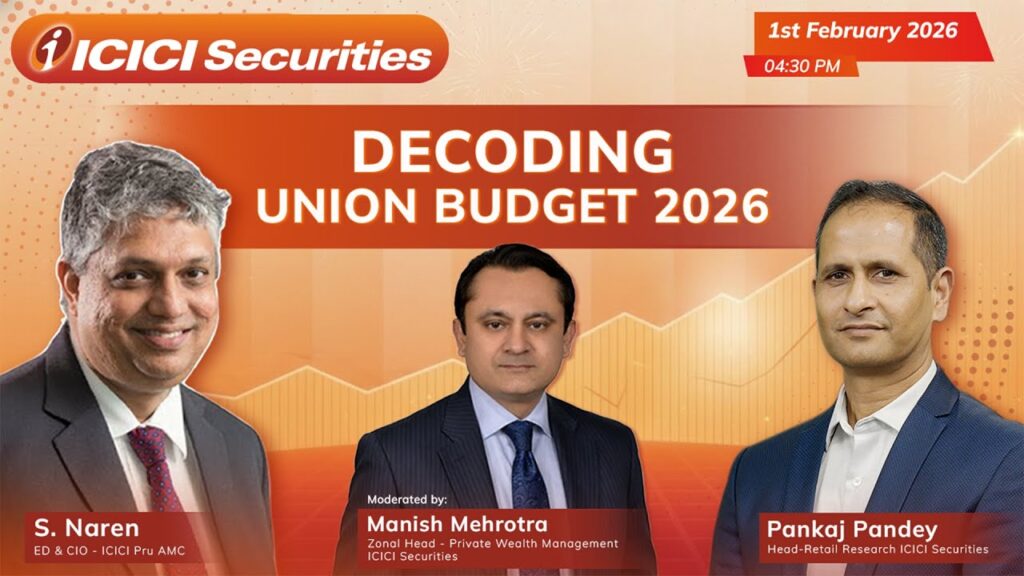
Decoding Union Budget 2026 | What It Means for Markets, Sectors & Investors | ICICI Direct

Summary Global markets remain buoyant while India continues to underperform relative to peers. Persistent INR weakness, sustained FPI outflows, elevated primary market supply, and limited exposure to global AI-led growth themes have weighed on sentiment. However, improving earnings momentum, valuation correction in high-growth segments, potential currency stabilization, and possible trade agreements with the US and West could help reverse flows and restore confidence. The environment may increasingly favour alpha-oriented strategies as new growth leaders emerge Global Economy The US dollar index (DXY) has weakened below 100, benefiting markets with stronger currencies. However, the Indian rupee has remained relatively weak, limiting India’s participation in global inflows. Emerging markets offering exposure to dominant AI-led growth themes have attracted capital, while India has relatively limited listed exposure to strong AI plays. Momentum reallocation within EM portfolios has also contributed to selling pressure in India. Domestic Factors Several domestic dynamics have contributed to market weakness: While domestic mutual fund inflows remain positive, the pace has moderated relative to earlier peaks Earnings Growth and Valuations Q2 corporate results exceeded expectations, and Q3 may continue this trend, potentially restoring confidence. Large-cap indices have broadly maintained valuations with earnings growth, while broader markets have seen valuation compression despite better earnings growth. High-growth segments have experienced sharper corrections, making them relatively better valued compared to the past. This valuation comfort could support performance once macro and flow headwinds ease. Flows and Liquidity Sustained FPI outflows have been a key headwind. A favorable trade deal with the US and broader Western economies could help stabilize the INR and restart global capital flows. Currency stability may trigger a virtuous cycle: Portfolio Positioning The fund house has: The focus remains on emerging growth leaders while adapting to evolving sector dynamics Structural Growth Themes Identified Long-term earnings growth potential is seen in: While global high-growth assets performed strongly in 2025, Indian high-growth segments underperformed. A mean reversion, if it occurs, could create a favorable setup for alpha generation. Risks Opportunities Low inflation, relatively low interest rates, valuation correction in growth spaces, and improving earnings momentum provide a constructive backdrop. Historically, the period post mid-March has delivered stronger returns relative to early calendar months, potentially offering tactical entry advantages. Closing View India’s underperformance has been driven more by flows and currency dynamics than by structural earnings weakness. With valuation resets in high-growth segments and macro stability improving, conditions may increasingly favor selective, alpha-driven strategies over passive index exposure. Improvement could coincide with currency stabilization and trade clarity over the next year. Mutual fund investments are subject to market risks. Read all scheme-related documents carefully.
Decoding Union Budget 2026 | What It Means for Markets, Sectors & Investors | ICICI Direct Read Post »

Fundspeak

Monthly Market Outlook (Feb 2026) by Prateek Agrawal

Summary Global markets remain buoyant while India continues to underperform relative to peers. Persistent INR weakness, sustained FPI outflows, elevated primary market supply, and limited exposure to global AI-led growth themes have weighed on sentiment. However, improving earnings momentum, valuation correction in high-growth segments, potential currency stabilization, and possible trade agreements with the US and West could help reverse flows and restore confidence. The environment may increasingly favour alpha-oriented strategies as new growth leaders emerge Global Economy The US dollar index (DXY) has weakened below 100, benefiting markets with stronger currencies. However, the Indian rupee has remained relatively weak, limiting India’s participation in global inflows. Emerging markets offering exposure to dominant AI-led growth themes have attracted capital, while India has relatively limited listed exposure to strong AI plays. Momentum reallocation within EM portfolios has also contributed to selling pressure in India. Domestic Economy Several domestic dynamics have contributed to market weakness: While domestic mutual fund inflows remain positive, the pace has moderated relative to earlier peaks Earnings Growth and Valuations Q2 corporate results exceeded expectations, and Q3 may continue this trend, potentially restoring confidence. Large-cap indices have broadly maintained valuations with earnings growth, while broader markets have seen valuation compression despite better earnings growth. High-growth segments have experienced sharper corrections, making them relatively better valued compared to the past. This valuation comfort could support performance once macro and flow headwinds ease. Flows and Liquidity Sustained FPI outflows have been a key headwind. A favorable trade deal with the US and broader Western economies could help stabilize the INR and restart global capital flows. Currency stability may trigger a virtuous cycle: Risks Opportunities Low inflation, relatively low interest rates, valuation correction in growth spaces, and improving earnings momentum provide a constructive backdrop. Historically, the period post mid-March has delivered stronger returns relative to early calendar months, potentially offering tactical entry advantages. Closing View India’s underperformance has been driven more by flows and currency dynamics than by structural earnings weakness. With valuation resets in high-growth segments and macro stability improving, conditions may increasingly favor selective, alpha-driven strategies over passive index exposure. Improvement could coincide with currency stabilization and trade clarity over the next year. Mutual fund investments are subject to market risks. Read all scheme-related documents carefully.
Monthly Market Outlook (Feb 2026) by Prateek Agrawal Read Post »

Fundspeak

Market Insight Fixed Income | November 2025 | Anurag Mittal CIO

Summary: India faces near-term growth pressure from tariffs, currency weakness, and fiscal strain, but GST reform promises medium-term consumption support. We remain neutral on equities with a defensive tilt, and in fixed income prefer short-tenor high-grade bonds over the pressured long end Global Economy Domestic Economy Investment Outlook Risks Opportunities Policy Watch Key Takeaways

, ,

Market Insight Fixed Income | November 2025 | Anurag Mittal CIO Read Post »

Fundspeak

Motilal Oswal on Monthly Insights November 2025

Summary Nikest Shah CIO on house views on macro economics and investment outlook Global Economy Domestic Economy Investment Outlook Risks Risks Opportunities Policy Watch Key Takeaway India stands strong within a global bull market phase.While valuations are elevated, robust domestic fundamentals and potential global triggers justify a cautiously optimistic outlook — with Balanced Advantage and Multi-Asset Funds as core allocations.

Motilal Oswal on Monthly Insights November 2025 Read Post »

Fundspeak

MARKET OUTLOOK & UPDATE ON BUSINESS CYLES FUND BY HSBC

Earnings Outlook Valuation Landscape Flows and Macro Startup Business Cycle Fund Positioning Consumption: Boost from GST cuts, pay hikes, tax relief.👉 Dynamic top-down + bottom-up approach; higher mid/small-cap tilt. Risks Key Rakeaways

, ,

MARKET OUTLOOK & UPDATE ON BUSINESS CYLES FUND BY HSBC Read Post »

Fundspeak

Equity Outlook for September 2024 with Ms. Shibani Kurian

Ms. Shibani Kurian discusses the strong Indian equity market outlook for September 2024, citing macro strength, earnings growth, and sector opportunities.

,

Equity Outlook for September 2024 with Ms. Shibani Kurian Read Post »

Fundspeak

Market Outlook

Summary Global inflation is slowly coming down, but rising commodity prices and supply chain disruptions are putting pressure on inflation. Central banks have started cutting rates, but it remains to be seen if expectations will be met. The Indian economy is performing well, with positive GDP growth and various sectors showing strength. The market outlook suggests a neutral weight to equity and potential opportunities in sectors like FMCG, private banks, and IT. Timestamped Highlights 00:00 -1:08 Global inflation is gradually decreasing, but rising commodity prices and supply chain disruptions are impacting inflation. 02:10 -3:40 Central banks have started cutting rates, but there is uncertainty if expectations will be met. 04:35 -7:45 The Indian economy is performing well, with positive GDP growth and strength in sectors like FMCG, private banks, and IT. 08:25 -9:35 The market outlook suggests a neutral weight to equity and potential opportunities in sectors such as FMCG, private banks, and IT. Key Insights Rising commodity prices and supply chain disruptions are putting pressure on inflation, despite global inflation slowly decreasing. This could impact the overall market outlook. Central banks have started cutting rates, but it remains uncertain if these expectations will be met. The potential impact on inflation and economic growth needs to be closely monitored. The Indian economy is showing positive signs, with GDP growth, strong sectors like FMCG, private banks, and IT. This presents opportunities for investors. The market outlook suggests a neutral weight to equity, indicating a balanced approach. However, there are potential opportunities in sectors like FMCG, private banks, and IT, which should be considered. The Indian market is influenced by factors such as government policies, geopolitical tensions, and global events. These factors should be taken into account when making investment decisions. Gold and silver prices are influenced by factors like central bank buying, production levels, and demand. These factors should be considered when analyzing the market outlook. The performance of different funds, including equity, hybrid, and debt funds, should be evaluated based on their track record and alpha generation. This can help investors make informed decisions and diversify their portfolios.

Market Outlook Read Post »