Author name: fundyantra.com

Fundspeak

Indian equities at a 10-year low premium — and earnings kept growing through it

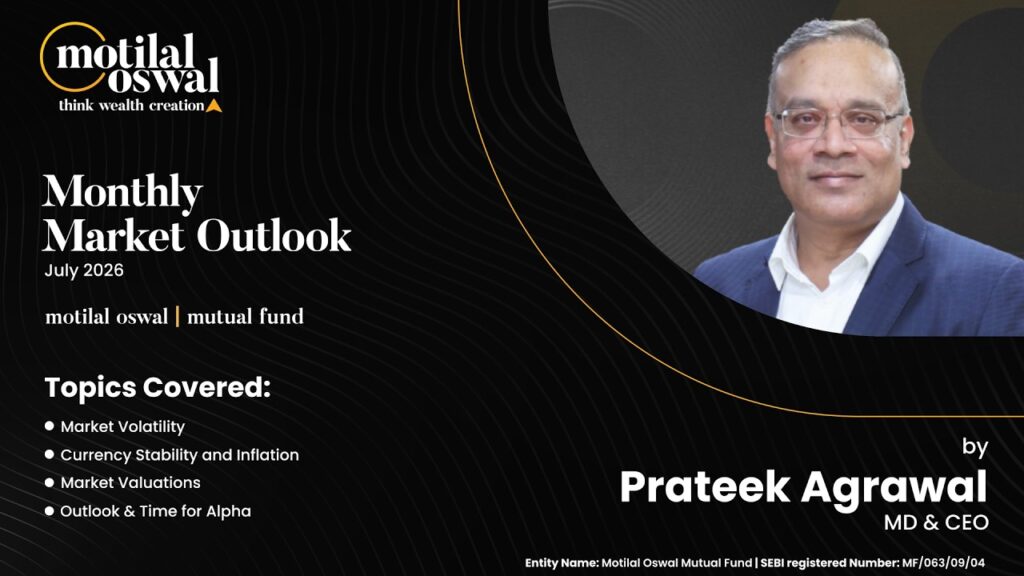
Motilal Oswal Mutual Fund July 2026 Monthly Market Outlook The Motilal Oswal market outlook July 2026 opens with a striking data point: Indian equities at a 10-year low premium to emerging markets — and earnings kept growing through it. That’s the setup. Oil is the unlock. While you wait for it, it’s time for alpha over beta. Motilal Oswal market outlook July 2026: the setup and the wait This month’s Motilal Oswal market outlook July 2026 briefing comes from Prateek Agrawal, CIO of Motilal Oswal Mutual Fund. Read alongside the Kotak July outlook and the DSP July outlook, a converging AMC view emerges on Indian large-caps at derated valuations while earnings compound. EM VALUATION PREMIUM 10-Year Low CRUDE Below $80 INR Stabilising STRATEGY Alpha over Beta Summary The Motilal Oswal market outlook July 2026 sits on a striking observation: Indian equities have been among the worst-performing asset classes over the past 18 months — not because earnings deteriorated (they didn’t), but because of external pressure from INR depreciation, high oil, and sustained FPI selling. The valuation premium to emerging markets is now at a 10-year low. Crude has already retraced below $80, and the NRI deposit scheme is expected to bring strong USD inflows that may have arrested INR depreciation — the very reason FPIs were selling. A drop in oil to February levels could take large-cap indices back to February levels, and from there, earnings do the work. While waiting for that unlock, Motilal Oswal’s framework is alpha over beta — value migration into spaces where growth is high and sustains longer: EVs, defense, renewables and BESS, and power and data centres riding AI demand. The detail The setup — earnings held, prices didn’t Indian equities have been among the worst-performing asset classes over the past 18 months — not because earnings deteriorated, they didn’t, but because of external pressure: INR depreciation, high oil, and sustained FPI selling. The result is a valuation premium to emerging markets now at a 10-year low. The setup is a market that’s been derated on flows, not fundamentals. The unlock — oil, INR, and what happens next Crude has already retraced below $80, a sustainable level for an economy like India. The NRI deposit scheme is expected to bring in strong USD inflows — which may have arrested the INR depreciation that was one of the key reasons FPIs were selling. A stable to strengthening INR is a factor foreign investors will re-evaluate Indian assets against. The specific unlock: a drop in oil to February levels may take large-cap indices back to February levels — and from there, earnings do the work. What could delay the unlock The Iran-US agreement still needs to materialize; the Strait of Hormuz remains a risk if it doesn’t. A monsoon shortfall severe enough to hit crops, fertilizer demand and government finances adds another layer of pressure on an already stretched fiscal position. None of these disqualify the thesis. They shape the timing. Alpha over beta — where value is migrating While you wait for the unlock, Motilal Oswal’s view is that it is time for alpha over beta. The framework is value migration — spaces where growth is high and sustains longer. Today that means: EVs over ICE vehicles, defense indigenization, renewables and BESS (battery energy storage systems), and power and data centres riding AI-driven demand. These are the sectors where the migration story is still early enough for growth to compound. What we are avoiding Spaces where the migration story is in its mature or disrupted phase are being avoided: traditional IT, where AI is rewriting the offshoring thesis, and PSU bank share gains, where the movement has slowed. The rule is the same on both sides — own where growth compounds; avoid where the thesis has already played out. A structural tailwind for alpha One structural tailwind being watched: large-caps are raising equity capital this cycle, unlike last year when mid and small caps dominated issuance. A shift in the composition of capital raising may support broader market performance and create a tailwind for alpha — active managers can position for the quality end without giving up growth. What this means for investors The takeaway Own the value migration while you wait for the oil-and-INR unlock — and don’t rely on the index to do the work: Tilt toward alpha, not beta. Passive index exposure captures the derated market, but active management is where the value-migration themes get owned. In this setup, alpha does more of the work than beta. Own the value-migration themes. EVs, defense indigenization, renewables and BESS, power and data centres — the spaces where growth is high and sustains longer than the average sector. Avoid the mature or disrupted stories. Traditional IT is being rewritten by AI; PSU bank share gains have slowed. When the migration is over, so is the alpha. Watch oil, INR, and the Strait of Hormuz. These are the timing variables. The setup is compelling; the trigger for the beta re-rating depends on how they resolve. Stay in the market, not just adjacent to it. The valuation premium is at a 10-year low with earnings intact — that’s a rare setup. Waiting on the sidelines risks missing the re-rating that follows the unlock. The Motilal Oswal market outlook July 2026 lines up alongside a broader converging AMC theme. Both Kotak and DSP flag Indian large-caps as the setup and private banks as the highest-conviction sector call. Motilal Oswal adds the alpha-over-beta framing while everyone waits for the oil unlock. For the underlying regulatory framework governing all three, see the Association of Mutual Funds in India. Equity Motilal Oswal AMC Market Outlook Alpha over Beta Value Migration EVs & Defense Renewables & BESS July 2026 Mutual fund investments are subject to market risks. Please read all scheme-related documents carefully. The views expressed are those of the speaker and do not constitute investment advice.

Indian equities at a 10-year low premium — and earnings kept growing through it Read Post »
Fundspeak

Large-cap isn’t a story call — it’s a flow call

ICICI Prudential Mutual Fund June 2026 Market Outlook & SIF Large-cap isn’t a story call — it’s a flow call. ICICI Pru leans large-cap because FIIs have sold continuously for 20 months while local SIPs flow into mid- and small-caps. That makes it a value setup. The missing piece is the trigger. LARGE CAPS Better Value FII FLOWS 20 Months of Selling CORE ALLOCATION Hybrid & Multi-Asset SIF Hybrid, Not Insurance Summary ICICI Pru’s June view leans into large-cap, and the reasoning is candid — it isn’t a fundamentals thesis, it’s a flow story. FIIs have sold large-cap continuously for 20 months while local SIPs keep flowing into mid- and small-caps. That makes large-cap the better-value segment, but the trigger for a re-rating is still missing. The AMC was also direct on SIF: it belongs with hybrid funds, not insurance products like LIC — it carries real loss-of-capital and liquidity risk. The broader house view is unchanged: asset allocation first, hybrid and multi-asset for the core, ultra-short and dynamic bond funds in debt, and gold only through multi-asset exposure. Returns from here are genuinely unpredictable — the discipline is to allocate, invest in hybrids, and leave it. The detail The large-cap call — and why it’s a flow story ICICI Pru’s June view leans into large-cap, and the reasoning given is candid: it isn’t a fundamentals thesis, it’s that FIIs have sold large-cap continuously for 20 months, across banks, oil & gas, auto, FMCG and IT — while local SIPs keep flowing into mid- and small-cap instead. That makes large-cap the better-value segment of the three: sustained, broad outflows are a value setup, not a story bet. It doesn’t need a war-ending or an oil-price catalyst to re-rate — only a reversal in flows. What’s missing — the trigger FIIs left because a global AI-capex boom has been pulling capital to Korea and Taiwan, with no fixed end date — only once a wave of IPOs (SpaceX, Anthropic, OpenAI) absorbs that boom. A forecast monsoon shortfall and high oil add further reasons the outflow could persist. Until flows actually turn, “cheap because money left” is a valuation observation, not yet a re-rating thesis. SIF — the right comparison The AMC was clear that SIF (Specialised Investment Fund) shouldn’t be compared to insurance like LIC — it belongs with hybrid funds, not capital-protection products. SIF carries real loss-of-capital and liquidity risk. The right comparison is other hybrids, not a guaranteed-return product. Investors evaluating SIF should benchmark it against the hybrid and multi-asset shelf, not against insurance or fixed-return alternatives. The broader house view Beyond the large-cap call, the AMC’s broader house view stays consistent: Asset allocation first, through hybrid and multi-asset funds. In debt, ultra-short/short-term funds and all-seasons dynamic bond funds. Gold only through multi-asset exposure, not standalone. The closing point is the most important one — returns from here are genuinely unpredictable. The discipline is to do the allocation, invest in hybrids, and leave it. What this means for investors The takeaway Treat large-cap as a value setup, not a directional bet — and let asset allocation do the heavy lifting: Lean toward large-cap, but know what you’re betting on. The case is a flow reversal, not a fundamentals story — own the segment for the value, not because a catalyst is imminent. Don’t crowd into mid- and small-caps via SIPs by default. Local flows have pushed these segments higher while FIIs sold the larger names — the risk-reward is now skewed against the crowded trade. Anchor the portfolio in hybrid and multi-asset. When returns are genuinely unpredictable, the asset allocation framework does more of the work than any single sector or cap-size call. In debt, stay short and flexible. Ultra-short and short-term funds for predictability; all-seasons dynamic bond funds for tactical positioning across the curve. Benchmark SIF correctly. Compare it against the hybrid shelf, not against LIC or capital-protection products. The risk profile is hybrid, not insurance. Equity ICICI Prudential Large Cap FII Flows SIF Hybrid Funds Multi-Asset June 2026 Mutual fund investments are subject to market risks. Please read all scheme-related documents carefully. The views expressed are those of the speaker and do not constitute investment advice.

Large-cap isn’t a story call — it’s a flow call Read Post »

Fundspeak

Mispricing over narrative: UTI’s June read on equity, innovation, and the crowded trade

UTI Mutual Fund June 2026 Equity Markets Two speakers, one message: don’t pay for the hype — pay for what’s mispriced. UTI’s June equity webinar argues the same discipline from opposite ends of the risk spectrum, with large-cap quality-growth on one side and high-optionality innovation on the other. US AI CONCENTRATION ~40% · Blinking Orange INDIA LARGE CAPS Raise Allocation SMALL & MID CAPS Crowded RUPEE Undervalued Summary On paper, UTI’s June equity webinar had two unrelated halves — Vetri Subramanyam on the macro-outlook, Nitan Jain on the UTI Innovation Fund. In substance, both argue the same thing from opposite ends of the risk spectrum: ignore the crowded narrative, look for what the market has mispriced. The macro half flags AI concentration in the US and crowded small- and mid-caps in India, while pointing to large-cap quality-growth as the better-positioned corner. The innovation half makes the same case in higher-risk form — owning businesses where the market pays for today’s engine and ignores the next one. Valuations and optionality are two faces of the same discipline: mispricing over narrative. The detail The macro half — concentration is the signal UTI flags that AI-linked names are now around 40% of the US market — concentration that, in past cycles, has tended to precede sharp reversals. They call it a “blinking orange” signal, not a timing tool. India is the mirror image: the crowd sits in expensive small- and mid-caps, while large-caps have entered the zone UTI’s own valuation indicator links to raising equity allocation — historically followed by positive one-year returns about 93% of the time. A rupee that now screens as undervalued caps the currency risk that usually drives foreign selling. The read: the crowded trades carry more risk than reward, and large-cap quality-growth is the better-positioned corner. The innovation half — same discipline, higher risk The UTI Innovation Fund is easy to mistake for an AI bet. The real thesis is optionality — owning businesses where the market pays for today’s engine and ignores the next one. UTI’s example: Eternal (formerly Zomato). At listing, the quick-commerce arm was given negative value; today, on UTI’s reading, it’s worth more per share than food delivery itself. It’s bought with discipline — about 27 stocks from a 65–70 name universe, 96% active share (how far a fund strays from its benchmark) — so it’s bottom-up, not an index in disguise. The honest caveat on innovation UTI is upfront about the risk profile of the Innovation Fund: early-stage, often loss-making businesses, large NAV swings, and only sensible for a 10-year-plus horizon. Optionality cuts both ways. The thesis only works when investors can sit through volatility long enough for the second engine to be priced in by the market. The throughline Valuations and optionality are two faces of the same discipline: mispricing over narrative. The part of the market most crowded into a story is rarely the part best-positioned from here. Whether the call is “rotate from small-mid to large-cap” or “own the second engine the market hasn’t priced,” the underlying instruction is the same. What this means for investors The takeaway Respond to mispricing, not headlines — at both ends of your portfolio: Rotate the core toward large-cap quality-growth. UTI’s valuation indicator now signals “raise allocation” — historically followed by positive one-year returns about 93% of the time. Trim the crowded trades. Expensive small- and mid-caps in India and AI concentration in the US both flash the same warning — crowded narratives carry more risk than reward. Treat innovation as a satellite, not a substitute. The Innovation Fund makes sense only as a small allocation alongside a quality core — and only if you can sit through 10+ years of volatility. Match horizon to product, honestly. Optionality-led strategies need a true 10-year-plus runway. If your horizon is shorter, stick with the macro half of the message — quality-growth at sensible valuations. Hold the discipline across both ends. Whether the position is large-cap rotation or a high-optionality satellite, the rule is the same — respond to mispricing, ignore the headline. Equity UTI Mutual Fund Large Cap Innovation Fund Optionality Valuation AI Concentration June 2026 Mutual fund investments are subject to market risks. Please read all scheme-related documents carefully. The views expressed are those of the speakers and do not constitute investment advice.

, ,

Mispricing over narrative: UTI’s June read on equity, innovation, and the crowded trade Read Post »

Fundspeak

Why short duration is an active call, not a hideout: UTI’s June fixed-income view

UTI Mutual Fund June 2026 Fixed Income Short-duration bonds: the safe call, or the smart one? With the repo at 5.25% and the rate-cut cycle effectively over, UTI’s 1–5 year tilt isn’t just defensive — it’s where you’re paid fairly for the risk you take. REPO RATE 5.25% · On Hold RATE-CUT CYCLE Effectively Over 1–5 YEAR SEGMENT Active Choice LONG DURATION Avoid Summary UTI’s June fixed-income view comes down to one position: stay at the front-to-middle of the yield curve — the 1–5 year segment — and avoid long-duration bets. The AMC frames it as caution: wait for clarity on inflation and oil before stretching duration. The conclusion looks reasonable; it’s the framing that may be worth a closer look. With the RBI repo rate at 5.25% and the rate-cut cycle effectively over, long bonds have lost their main reason to rally. Short duration here isn’t a holding pattern — it’s an active choice to collect steady carry where you’re paid fairly for the risk you take. The detail UTI’s stated view UTI’s June fixed-income view comes down to one position: stay at the front-to-middle of the yield curve — the 1–5 year segment — and avoid long-duration bets. The AMC frames it as caution: wait for clarity on inflation and oil before stretching duration. The conclusion looks reasonable. It’s the framing that may be worth a closer look. Why the long end has lost its rally case With the RBI repo rate at 5.25% and the rate-cut cycle effectively over, long bonds have lost their main reason to rally — there’s no falling-rate tailwind left to deliver capital gains. What remains at the long end is the risk: heavy government borrowing supply, plus oil and inflation overhang. So the long end is asking investors to take real risk for very little extra yield over the short end. That appears to be a less attractive trade. Why short duration wins right now Short duration wins right now — not as a defensive hideout, but because it’s where you’re paid fairly for the risk you take. You collect the carry, stay liquid, and avoid a duration bet with limited upside catalyst. Steady income at the front of the curve, without taking on the risks sitting at the long end. The one scenario that flips this If oil stays soft after the ceasefire and inflation undershoots, the RBI could surprise with another cut — the only case that rewards extending duration. On today’s odds, that appears to be a low-probability event. What this means for investors The takeaway Short duration here is an active choice, not a holding pattern. Here’s how that translates into portfolio action: Take the steady income at the front of the curve. The 1–5 year segment is where you’re paid fairly for the risk — collect the carry, stay liquid. Avoid the long end. With the rate-cut cycle effectively over, long bonds offer little upside catalyst — but carry real risk from supply, oil, and inflation overhang. Treat duration as an active call, not a default. Short duration here is a deliberate position — not a defensive hideout while waiting for clarity. Watch one scenario for a duration switch. If oil stays soft and inflation undershoots, an RBI surprise cut would reward extending duration — but on today’s odds, that’s a low-probability event. Match duration to your horizon. Align fund choices with your time horizon — accrual and short-duration funds suit shorter goals; flexible bond strategies allow tactical positioning. Fixed Income UTI Mutual Fund Short Duration Yield Curve RBI Policy Carry Trade June 2026 Mutual fund investments are subject to market risks. Please read all scheme-related documents carefully. The views expressed are those of the speaker and do not constitute investment advice.

, , ,

Why short duration is an active call, not a hideout: UTI’s June fixed-income view Read Post »

Fundspeak

Diversify, don’t react: Kotak’s June playbook on equities, gold and multi-asset

Kotak Mutual Fund 08 June 2026 Market Outlook Kotak Mutual Fund stays neutral on equities, overweight on gold, and leans on multi-asset and flexicap strategies — a diversification-first stance for a market still wrestling with crude, currency, and monsoon risk. EQUITY STANCE Neutral GOLD Overweight MID CAPS Marginal OW SMALL CAPS Underweight Summary Kotak Mutual Fund maintains a neutral stance on equities and an overweight position on gold, with a trading allocation to silver. Within equities, the AMC is marginally overweight on mid-caps, equal-weight on large-caps, and underweight on small-caps. It remains constructive on financial services, consumption, e-commerce, healthcare, auto, cement, and infrastructure. Multi-asset, multicap, and flexicap strategies are highlighted as suitable approaches in the current environment, with the broader message being diversification, SIP discipline, and risk management over short-term reactions. The detail Macroeconomic outlook Kotak Mutual Fund highlighted that global markets continue to be influenced by geopolitical tensions, elevated commodity prices, rising bond yields, and currency volatility. The US economy remains relatively resilient against this backdrop. For India, the key challenges include high crude oil prices, rupee weakness, trade deficit concerns, and monsoon-related uncertainty — a mix that argues for diversification rather than concentrated positioning. Market & asset allocation view The AMC maintains a neutral stance on equities, while remaining overweight on gold and maintaining a trading allocation to silver. Within equities, Kotak is marginally overweight on mid-caps, equal-weight on large-caps, and underweight on small-caps — a tilt toward quality and a reluctance to chase the most richly priced segment of the market. Sectors & strategies The AMC remains constructive on financial services, consumption, e-commerce, healthcare, auto, cement, and infrastructure — a mix of structural growth and cyclical recovery themes. Multi-asset allocation, multicap, and flexicap strategies were highlighted as suitable approaches in the current environment — vehicles that allow active managers to navigate across market caps and asset classes as conditions evolve. Key risks to monitor The principal risks identified are sustained high crude oil prices, further rupee weakness, a widening trade deficit, and monsoon outcomes — factors that could each independently weigh on currency, inflation, and rural consumption. What this means for investors Action points Kotak’s guidance for navigating June 2026 centres on diversification, SIP discipline, and treating gold as a portfolio building block — not a tactical trade: Maintain a diversified asset allocation approach. Spread exposure across equity, debt, and gold rather than concentrating in any single asset. Continue SIPs and long-term investing. Systematic, disciplined participation smooths out entry timing and lets compounding do the work. Use multi-asset, multicap, or flexicap strategies. These vehicles allow active managers to shift across asset classes and market caps as conditions evolve. Consider gold as part of portfolio allocation. Beyond a tactical hedge, gold can serve as a structural diversifier in a portfolio facing currency and geopolitical risks. Focus on risk management over short-term moves. Position-sizing, diversification, and asset allocation matter more than reacting to daily news flow. Asset Allocation Kotak Mutual Fund Market Outlook Gold Multi-Asset Flexicap Mid & Small Caps June 2026 Mutual fund investments are subject to market risks. Please read all scheme-related documents carefully. The views expressed are those of the speaker and do not constitute investment advice.

,

Diversify, don’t react: Kotak’s June playbook on equities, gold and multi-asset Read Post »

Fundspeak

Weak macro, broader markets: where Motilal Oswal sees the next opportunity

Motilal Oswal Asset Management 01 June 2026 Monthly Market Outlook Motilal Oswal sees weak macro as an opportunity — mid & small caps may have already absorbed the worst of FPI selling, and broader markets are showing stronger earnings growth than narrow large-cap indices. MACRO VIEW Weak = Opportunity MID & SMALL CAPS Worst Likely Past BROADER MARKETS Earnings Edge STRATEGY Active Preferred Summary Motilal Oswal Asset Management sees the current weak macro backdrop as an opportunity rather than a reason for caution. The AMC believes mid and small caps have likely already absorbed the worst of FPI ownership decline, while broader markets continue to deliver stronger earnings growth than narrow large-cap indices. Growth opportunities are visible across both new-economy themes — EVs, EMS, renewables, defence, digital platforms — and cyclical recovery plays such as capital markets, select NBFCs, and metals & mining. The AMC favours active strategies and broader market exposure, with the key risk to monitor being prolonged elevated crude prices. The detail Macroeconomic outlook Motilal Oswal Asset Management highlighted that weak macro may present opportunities for investors. The current environment is being shaped by geopolitics-led high oil prices, pressure on forex reserves, FPI selling, and INR depreciation. These pressures are visible across markets — but, in the AMC’s view, the very conditions creating short-term noise are also setting up the opportunity for selective, disciplined entry into well-positioned segments. Market & equity view The AMC noted that mid and small caps may have already seen the worst of FPI ownership decline, suggesting the heaviest selling pressure in these segments may be behind us. Broader markets are also showing stronger earnings growth compared to narrow large-cap indices — reinforcing the case for looking beyond the top-100 names. Growth opportunities Motilal Oswal sees opportunities across a wide set of themes: EVs, EMS, renewables, defence, recycling, capital markets, select NBFCs, digital platforms, electronics, luxury, metals & mining, and select software companies. The mix spans both structural new-economy growth and cyclical recovery plays — pointing to an environment where stock and sector selection matter more than passive index exposure. Key risk to monitor The principal risk identified by the AMC is the possibility of high oil prices sustaining for longer, which would extend pressure on the currency, current account, and inflation — and could change the macro setup more durably than a transient shock. What this means for investors Action points Motilal Oswal’s guidance for navigating June 2026 centres on leaning into broader markets, favouring active strategies, and not flinching at short-term macro noise: Favour active mutual fund strategies. In an environment where stock selection drives returns, active management has an edge over passive index exposure. Consider broader market opportunities. Earnings growth remains stronger outside narrow large-cap indices — broader exposure may be where the next leg of returns comes from. Stay invested in growth-oriented themes. EVs, EMS, renewables, defence, digital platforms, and other structural growth segments offer long-term potential. Avoid reacting to short-term macro weakness. The very pressures creating noise today may be setting up the opportunity — let the framework do the work. Monitor the key risk of elevated oil sustaining longer. Prolonged high crude prices would extend currency, current account, and inflation pressures. Equity Motilal Oswal AMC Market Outlook Mid & Small Caps Active Strategies Growth Themes June 2026 Mutual fund investments are subject to market risks. Please read all scheme-related documents carefully. The views expressed are those of the speaker and do not constitute investment advice.

, , ,

Weak macro, broader markets: where Motilal Oswal sees the next opportunity Read Post »

Fundspeak

Crude swings, FII volatility & valuation reset: time to add equity

UTI Mutual Fund 12 May 2026 Equity Markets UTI’s valuation indicator has moved into the “increase equity” zone, with large caps better placed than mid and small caps amid global uncertainty. EQUITY ALLOCATION Increase LARGE CAPS Comfortable MID & SMALL CAPS Expensive STYLE BIAS Value tilt Summary UTI sees Indian equity markets stabilising after crude swings, geopolitical tensions, and FII volatility. The AMC’s proprietary valuation indicator has moved into the “increase equity” zone, with large caps looking more attractive than richly priced mid and small caps. Value is positioned to potentially mean-revert versus growth and quality, and investors are advised to add equity in a staggered manner with disciplined asset allocation. The detail Macroeconomic outlook Equity markets have faced sharp crude oil swings, geopolitical tensions in West Asia, rupee pressure, and continued FII volatility. Despite this uncertainty, markets have repeatedly attempted to stabilise as investors reassess the long-term picture. Globally, the US economy remains relatively resilient to crude oil shocks because energy intensity has reduced and the US has become a net energy exporter. Risks, however, remain from elevated corporate profits, high AI-led capex, uncertain returns from AI investments, and the impact of higher US bond yields on equity valuations. India-specific risks For India, the key risks include elevated crude oil prices, supply-chain disruptions, fertilizer availability, current account pressure, and currency weakness. India’s goods trade balance remains a structural challenge, though services exports continue to provide meaningful support to the overall external account. Market & equity view UTI’s proprietary equity valuation indicator is currently in the “increase equity allocation” zone, suggesting investors may consider raising equity exposure in a staggered manner. Large-cap valuations appear more comfortable compared to mid and small caps, which remain relatively expensive. The AMC also highlighted that growth and quality have underperformed value, creating scope for a possible style reversal. What this means for investors Action points UTI’s guidance for navigating the current setup centres on staggered allocation, discipline, and avoiding emotional decisions: Increase equity allocation in a staggered manner. Phase in additions over time rather than deploying lumpsum at one go. Prioritise asset allocation and risk management. Stick to a target mix that fits your goals rather than reacting to short-term moves. Consider hybrid funds for lumpsum allocation. Useful for cushioning short-term volatility while keeping equity exposure. Stay disciplined with a long-term approach. Avoid panic exits during negative news flow and let the asset allocation framework do the work. Equity UTI Mutual Fund Market Insights Asset allocation Large cap Value investing May 2026 Mutual fund investments are subject to market risks. Please read all scheme-related documents carefully. The views expressed are those of the speaker and do not constitute investment advice.

, , ,

Crude swings, FII volatility & valuation reset: time to add equity Read Post »

Fundspeak

Sticky inflation, oil volatility & duration caution: fixed income under pressure

UTI Mutual Fund Anurag Mittal · Head of Fixed Income 08 May 2026 Fixed Income UTI’s Anurag Mittal sees liquidity, not duration, as the safer anchor for fixed income positioning through 2026. DURATION VIEW Cautious LIQUIDITY Comfortable INFLATION Sticky RBI STANCE Patient SUMMARY Elevated oil prices, geopolitical disruptions, and potential El Niño risks are keeping inflation sticky. RBI is likely to stay patient, prioritising liquidity over rate action. Front-end fixed income strategies look better placed than long-duration bets in this uncertain macro setup. Key takeaways 1Markets have shifted from expecting global rate cuts to pricing in tighter monetary conditions due to sticky inflation risks. 2Sustained crude above expected levels could trigger stagflationary pressures globally, especially for oil-importers like India. 3RBI is expected to prioritise liquidity support while staying cautious on rate action until second-round inflation effects emerge. 4Front-end yield curve positioning remains preferable amid uncertainty around growth, inflation, and fiscal dynamics. 5El Niño risks and higher fertilizer costs could disproportionately impact food inflation through pulses, oilseeds, and rain-fed crops. 6Liquidity conditions remain supportive due to RBI interventions and anticipated dividend transfers, anchoring short-term rates. What this means for investors Strategy by investment horizon UTI’s framework maps investor time horizon to the most suitable fixed income strategy in the current environment: HORIZON 3–12 months Money market or low-duration strategies. Short maturities limit exposure to rate volatility while capturing the comfortable liquidity environment. HORIZON ~12 months Short-term or corporate bond strategies. A modest step up the curve with reasonable accrual, without taking aggressive duration risk. HORIZON 2+ years Income plus arbitrage strategies. Suited for investors comfortable with a longer holding period and looking for tax-efficient accrual. Avoid aggressive duration calls until there is better clarity on crude oil, inflation trajectory, and RBI policy direction. The detail Macroeconomic outlook Global fixed income markets remain under pressure from geopolitical uncertainty, crude oil volatility, tariff-related inflation, and shifting US interest rate expectations. While manufacturing activity has improved, this may partly reflect frontloading due to supply-chain concerns. Rising input costs across manufacturing and services continue to create sticky inflation risks. India-specific risks The key risks for India remain crude oil prices, fertilizer costs, food inflation, monsoon distribution, and El Niño uncertainty. However, El Niño does not always translate into a weak monsoon — the actual impact depends on rainfall distribution and crop sensitivity, particularly for pulses, oilseeds, and rain-fed crops. Central bank view: Fed & RBI UTI expects the US Federal Reserve to remain patient and data-dependent. For India, RBI is also likely to stay in wait-and-watch mode, since current inflation pressure is largely supply-side driven. Even if inflation rises toward 5–5.5%, RBI may not hike immediately unless second-round inflation effects appear. Liquidity is expected to remain comfortable over the next 6–12 months, supported by banking system surplus liquidity and expected RBI dividend flows. Duration positioning UTI is more constructive on the front end of the yield curve. Money market, low-duration, short-term, and corporate bond strategies appear better placed than aggressive long-duration funds. Long-duration bonds may remain vulnerable to crude oil shocks, inflation surprises, fiscal pressure, currency movement, and geopolitical risks. Fundyantra Insight The evolving macro setup suggests that liquidity visibility — not duration aggression — may become the primary anchor for fixed income positioning in 2026. Front-end strategies offer the cleaner risk-reward until RBI’s stance and the crude trajectory become clearer. Fixed income UTI Mutual Fund Market Insights RBI policy Duration view May 2026 Mutual fund investments are subject to market risks. Please read all scheme-related documents carefully. The views expressed are those of the speaker and do not constitute investment advice. Fundyantra’s commentary is editorial in nature and should not be construed as a recommendation.

, , ,

Sticky inflation, oil volatility & duration caution: fixed income under pressure Read Post »

Fundspeak

Oil Shock, Global Realignment & Valuation Discipline: Navigating Market Volatility

Summary On 07-May-2026, Nilesh Shah highlighted elevated oil prices, geopolitical disruption, and slowing global growth as key macro risks. While India’s external vulnerabilities persist, valuation comfort in large caps, resilient domestic flows, and selective sector opportunities continue to support a neutral but disciplined market stance. Key Takeaways Fundyantra Insight The discussion suggests that future market leadership may increasingly depend on valuation discipline, energy resilience, and adaptability to structural shifts like AI and geopolitical fragmentation. Mutual fund investments are subject to market risks. Read all scheme-related documents carefully.

,

Oil Shock, Global Realignment & Valuation Discipline: Navigating Market Volatility Read Post »

Fundspeak

Mean Reversion, SIP Discipline & Large-Cap Valuation Comfort: Reading India’s Macro Cycle

Summary On 06-May-2026, Sahil Kapoor of DSP Netra emphasized SIP discipline, large-cap valuation comfort, and probable cyclical recovery in consumption and corporate capex. While macro uncertainty persists, balance-sheet strength and improving credit conditions could support selective long-term opportunities. Key Takeaways Fundyantra Insight The webinar reinforces a key market reality: sustainable alpha may increasingly come from patience, valuation discipline, and avoiding behavioural mistakes rather than aggressive forecasting. Mutual fund investments are subject to market risks. Read all scheme-related documents carefully.

Mean Reversion, SIP Discipline & Large-Cap Valuation Comfort: Reading India’s Macro Cycle Read Post »

Fundspeak

Oil Volatility, FPI Flows & Emerging Domestic Themes: Positioning for Alpha -May 2026

Summary On 01-May-2026, Prateek Agrawal, Motilal Oswal Asset Management highlights oil-driven macro pressure, FPI outflows, and forex stress weighing on markets. Easing crude supports sentiment, while domestic themes-EVs, defense, renewables, and manufacturing- offer alpha opportunities amid modest earnings recovery. Key Takeaways Fundyantra Insight Macro stress is concentrated in oil-while micro-opportunities are shifting toward structural domestic themes, creating a clear divergence for alpha generation Mutual fund investments are subject to market risks. Read all scheme-related documents carefully.

Oil Volatility, FPI Flows & Emerging Domestic Themes: Positioning for Alpha -May 2026 Read Post »

Fundspeak

Sticky Inflation, Yield Volatility & Tactical Duration: Navigating Fixed Income

Summary On 09-Apr-2026, Anurag Mittal (Head of Fixed Income), UTI Mutual Fund, highlights inflation risks from oil shocks, uncertain rate trajectory, and volatile yields. While liquidity remains supportive, duration calls stay tactical; accrual strategies and selective duration positioning offer opportunities amid macro uncertainty and evolving policy stance. Key Takeaways Fundyantra Insight In a regime of uncertain rate direction, carry and disciplined duration management may outperform directional interest rate bets. Mutual fund investments are subject to market risks. Read all scheme-related documents carefully.

Sticky Inflation, Yield Volatility & Tactical Duration: Navigating Fixed Income Read Post »

Fundspeak

Global Uncertainty, Earnings Moderation & Selective Opportunities: Rebalancing Equity Strategy

Summary On 08-Apr-2026, Mr. Vetri Subramanyam (MD & CEO) and Mr. Ajay Tiyagi (Head of Equities), UTI Mutual Fund, highlight geopolitical risks, slowing global growth, and earnings moderation. While flows remain mixed, improving large-cap valuations and domestic cyclicals present selective opportunities amid elevated macro and liquidity uncertainty. Key Takeaways Fundyantra Insight With beta tailwinds fading, markets are entering a phase where disciplined allocation and earnings visibility will drive sustainable alpha. Mutual fund investments are subject to market risks. Read all scheme-related documents carefully.

Global Uncertainty, Earnings Moderation & Selective Opportunities: Rebalancing Equity Strategy Read Post »

Fundspeak

Geopolitics, Oil Shock & Valuation Reset: Navigating Volatility with Selective Risk

Summary On 07-Apr-2026, Mr. Nilesh Shah (Managing Director, Kotak Mutual Fund) flags oil-led inflation risks, fragile global growth, and continued FII outflows. While macro headwinds persist, large-cap valuations have normalized, supporting selective allocation; commodities and domestic cyclicals offer tactical opportunities amid elevated volatility. Key Takeaways Fundyantra Insight Markets are transitioning from liquidity-driven excess to valuation discipline—allocation alpha will hinge on selectivity, not market direction. Mutual fund investments are subject to market risks. Read all scheme-related documents carefully.

Geopolitics, Oil Shock & Valuation Reset: Navigating Volatility with Selective Risk Read Post »

Fundspeak

Market Reset Driving Tactical Equity Re-Entry

Summary On 06-Apr-2026, Sahil Kapoor (Head – Products & Market Strategist, DSP Mutual Fund) shifts to a constructive equity stance as valuations normalize, sentiment weakens, and flows reverse. While macro risks (oil, flows) persist, improving large-cap valuations and mean reversion dynamics support calibrated equity allocation. Key Takeaways Fundyantra Insight Markets rarely signal comfort at inflection points-current pessimism, not fundamentals, is the primary barrier to allocation Mutual fund investments are subject to market risks. Read all scheme-related documents carefully.

Market Reset Driving Tactical Equity Re-Entry Read Post »