equity market outlook

Fundspeak

We are in the last leg of consolidation

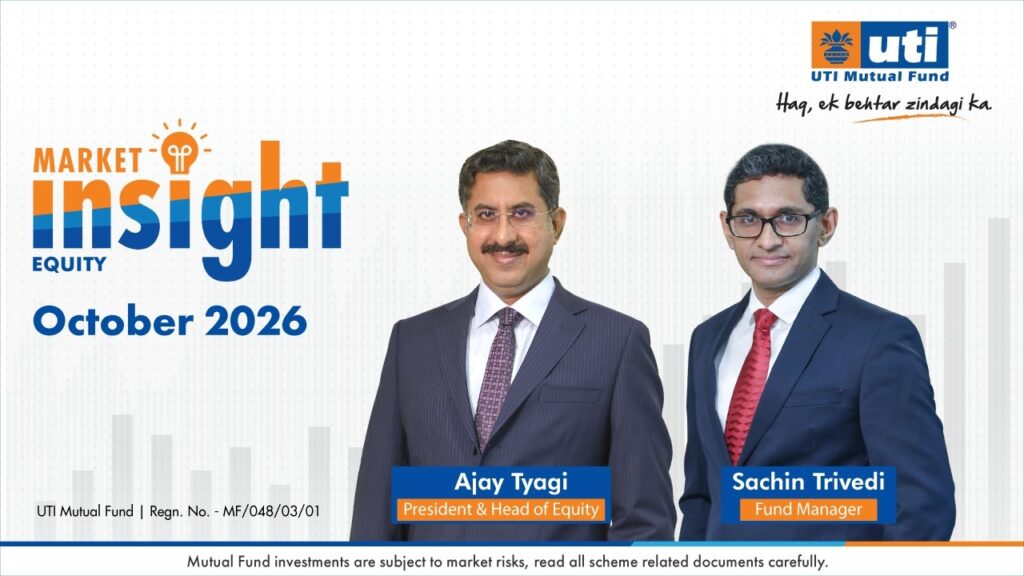
UTI Mutual Fund October 2026 Equity Markets The UTI equity market October 2026 call from Ajay Tyagi is mean reversion. India’s five-year returns against the emerging market index are at their lowest level, large caps have already reverted while small caps carry a premium of almost 60%, and he says we are in the last leg of consolidation. UTI equity market October 2026: the mean-reversion case and the last leg of consolidation This month’s UTI equity market October 2026 briefing comes from Ajay Tyagi and Sachin Trivedi at UTI Mutual Fund. Read alongside UTI’s October fixed income webinar and the Kotak October D-Kode outlook. LARGE CAPS 18x vs 17x · Reverted MID CAPS 24 vs 18 · ~30% Above SMALL CAPS ~60% Premium · Weakest WHERE WE ARE Last Leg of Consolidation Summary The UTI equity market October 2026 read: markets are mean reverting, Ajay Tyagi says, and India’s five-year rolling returns against the emerging market index have reached their lowest level — which he reads as a contrarian signal that India should do better in coming years. Part of the reason for the consolidation is earnings growth of just 3% and 8% over two years, about 6% on average; he expects mid-teens growth in FY26, FY27 and FY28. The detail The yield gap, and why foreign flows have been weak Fixed income investors seek yield while protecting the downside, and India’s yield gap over US Treasuries has narrowed to 190 basis points — under 2%, against roughly 7% ten years ago. With the rupee depreciating around 3% against the dollar over the long run even before volatility, that is not a profitable trade; he thinks that while the gap stays this narrow India will not attract fixed income investors. Equity investors look at underlying growth, so the pickup of the last two quarters should bring interest back and, hopefully, turn weak foreign flows positive — if, he adds, the economy keeps showing growth and earnings visibility. And he says this with US yields at 5 to 6%, which over 30 to 40 years is the average: investors anchoring on 2010 to 2022 are misreading today’s yields, because that phase was abnormal. Fundamentals first, then valuations Averaged across multiple 10-year rolling periods over roughly 20 years, large cap revenue growth is highest at 11% against 10% and 9% for mid and small; midcap operating profit growth runs about 1% above large cap while small caps are much lower; small cap net profit growth has been the weakest. That, he thinks, is probably why mid caps have given 1 to 2% better returns than large caps over long periods — but he says small cap return expectations should be kept below large cap. Rolling returns over the same multiple 10-year periods nonetheless show mid and small ahead of large, which he attributes to the valuation level small caps trade at. Large caps are at 18 times against a 17 times average, a 5% premium, with mean reversion already done. Mid caps have also reverted a good deal but are still at 24 against 18, about 30% above. Small caps carry a premium of almost 60% and have not mean reverted — which is why UTI’s view is that they will be the weakest performing segment over the next two to three years. The largest part of the market is also the cheapest India’s mega caps have done the opposite of the US, where the top 10 carried the market. Here the top 10 have undershot, with returns below their own averages, which he says makes them attractive: the BSE 100 is near its average and its top 25 stocks are below the long-term average. The same reversion applies by sector — PSUs, capital goods, power and metals sit well above their averages, while IT, FMCG, consumer, consumer durables and banking sit below. Banking, IT and FMCG are already close to their bottom levels over a full cycle, one reason UTI wants to take a contrarian call on them; UTI thinks those sectors should do well over the next three to five years. On 25 years of Nifty 500 data, 2000 to 2003 delivered minus 26% and then 500 to 550% over four years; the financial crisis took markets down about 60%, followed by roughly 140% in two. He reads today as closest to 2010 to 2013 — three years of no returns before the rally from mid-2013. This phase is two years old and he says it is hard to say when markets turn, possibly another three to nine months, but that we are in the last leg of consolidation. What this means for investors Ajay Tyagi’s own summing up, plus the Q&A Rates are rising here too. A 25 bps hike has happened and two more could follow, because India cannot keep its yield differential with the US too narrow. He thinks crude at current levels is manageable; a move to 130 to 140 that settles there could be a serious problem. He recalls 2011-12, when crude was elevated for about two years during the Libya war, and argues that inflation-adjusted today’s dollar price is not comparable. He flags some inflation risk and a wider current account deficit this financial year. Keep asset allocation front and centre. Markets have become attractive, but global factors argue for risk mitigation, so some allocation in hybrid funds; within pure equity the tilt stays towards large cap. Stay staggered and keep the SIP going — after a weak phase, he says, a strong phase has always followed. On style, value has done very well for four to five years while quality has disappointed; he expects that to reverse. From the Q&A: consumption is 65 to 70% of GDP and has picked up over two quarters after income tax cuts, GST cuts and state welfare schemes, with the Eighth Pay Commission due next year. The UTI equity market October 2026 briefing sits alongside UTI’s October fixed income webinar and the Kotak October D-Kode outlook.

,

We are in the last leg of consolidation Read Post »
Motilal Oswal AMC October 2026 Dear Investor Prateek Agrawal - FundYantra Fundspeak
Fundspeak

It is time to distinguish between consistency and alpha” (the note’s own framing

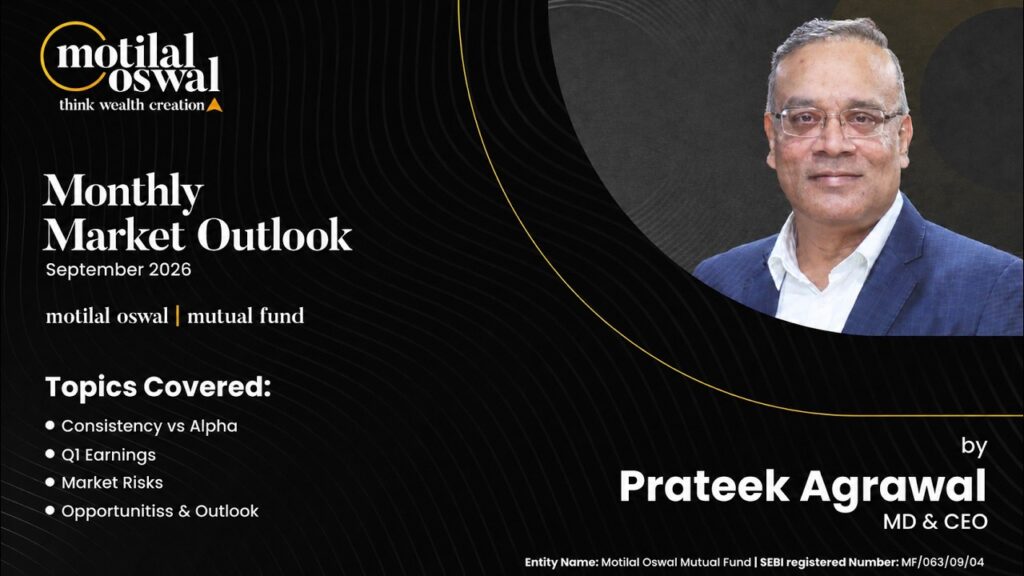
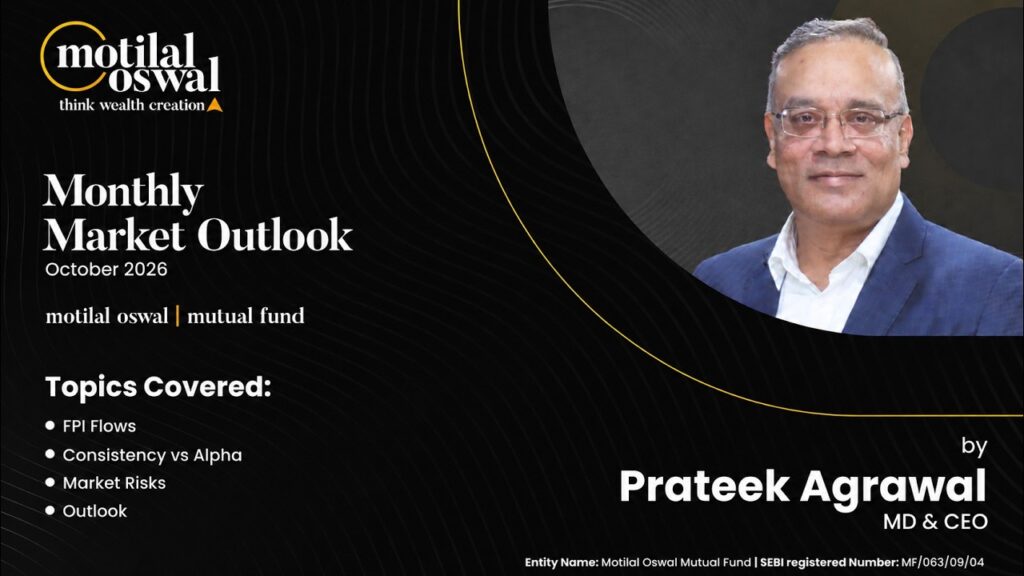
Motilal Oswal AMC October 2026 Dear Investor The Motilal Oswal October 2026 Dear Investor note: FPIs may take a while to return, and with growth stronger outside the large cap indices, consistency with the Nifty may no longer travel with better relative performance. Motilal Oswal October 2026: consistency versus alpha This month’s Motilal Oswal October 2026 Dear Investor note comes from Prateek Agrawal at Motilal Oswal Mutual Fund. Read alongside the DSP Netra October edition and the Motilal Oswal September outlook. WHY FPIs ARE SELLING Rates · Rupee · Growth Elsewhere WHAT HAS IMPROVED EM Valuations · Record Reserves THE DISTINCTION Consistency vs Alpha OVERALL OUTLOOK A Lot in the Price Summary The Motilal Oswal October 2026 note covers FPI selling, the broader market’s higher earnings growth compared with large cap indices, and the possible implications for market performance. FPIs are selling emerging markets and it might be a while before they become buyers. Growth outside the major indices has been stronger than growth within them — so, Motilal Oswal says, it is time to distinguish between consistency and alpha. The detail FPIs are selling emerging markets; it might be a while before they become buyers Rates rose globally, including in Japan and the US, increasing the cost of capital and reducing outward flows. A weak rupee could affect FPI returns; Motilal Oswal believes currency stability is needed before FPIs reconsider India. Higher oil prices are another risk. Motilal Oswal believes FPIs came for growth and remain heavily invested in earlier leaders such as IT services and private banks, where growth has moderated. Newer growth leaders are smaller and may not absorb those outflows. Global AI opportunities and large upcoming US IPOs also compete for capital. There are some positives India’s valuations have improved relative to other emerging markets. Large US-dollar deposits raised by banks have helped lift forex reserves to a record and supported confidence. The AI trade may be becoming more expensive and uncertain. As adverse factors reverse, India could regain favour. The overall impact of duties may be limited outside specific sectors, although volatility could persist. It is time to distinguish between consistency and alpha What the AMC says it was missing was this distinction during the 2008 to 2020 period: the Nifty led earnings growth, so constructs that stayed close to the Nifty provided both consistency and strong relative performance. Now that the broader market is growing faster, the two may not necessarily occur together. China plus one after COVID let governments protect domestic manufacturing, there was a thrust to Make in India, and new spaces emerged — digital, EVs, renewables, capital market participants — most of whose companies did not exist 10 years ago. Constructs that move away from the index could have a greater chance of stronger outcomes over a period of time, though their consistency relative to the index may differ. What this means for investors The note’s own outlook The note’s own outlook — the AMC’s views, not recommendations: There is a lot in the price. Uncertainties would remain, but investors may learn to live with them. Domestic focused businesses, and those with a US manufacturing base, may be relatively less impacted. Software and realty may stabilise as AI-related jobs emerge and AI companies seek returns on their investments. Newer spaces continue to emerge and may present alpha opportunities; since the broad market keeps growing faster, the AMC believes it continues to be time for alpha. The Motilal Oswal October 2026 Dear Investor note sits alongside the DSP Netra October edition and the Motilal Oswal September outlook. For the underlying regulatory framework, see the Association of Mutual Funds in India. Equity Motilal Oswal AMC Dear Investor FPI Flows Earnings Growth Alpha October 2026 Mutual fund investments are subject to market risks. Please read all scheme-related documents carefully. The views expressed are those of the AMC and do not constitute investment advice.

, , , , ,

It is time to distinguish between consistency and alpha” (the note’s own framing Read Post »

Motilal Oswal Mutual Fund September 2026 Market Outlook - FundYantra Fundspeak
Fundspeak

The distinction between consistency and alpha — because growth is now higher outside of large cap indexes

Motilal Oswal Mutual Fund September 2026 Market Outlook The Motilal Oswal market outlook September 2026 argues this is a time when investors would have to understand the distinction between consistency and alpha — because growth is now higher outside of large cap indexes. Motilal Oswal market outlook September 2026: the consistency-vs-alpha distinction This month’s Motilal Oswal market outlook September 2026 briefing comes from Motilal Oswal Mutual Fund. Read alongside the Kotak September outlook and the DSP Netra September foundational edition. CONSISTENCY Close to Index ALPHA Excess Over Benchmark WHERE GROWTH IS Outside Large Caps Q1 EARNINGS Good, Across the Board Summary The Motilal Oswal market outlook September 2026 opens on a definitional distinction. Consistent returns are generally associated with performance closer to the relevant index returns; alpha refers to excess return over a benchmark. This edition is about why, now that growth is higher outside of large cap indexes, the two need separating. The detail The difference between consistency and alpha Consistent performance is achieved with constructs close to index and being very index aware. Active ratios may be high, but the construct could still be close — a stock held outside the index but in the same sector. Up until FY20 and FY21 large caps delivered better earnings growth versus small and midcaps over most periods since the start of the century, and outcomes from constructs away from the index were not satisfactory. Now growth is higher outside, so such constructs may provide greater opportunity over a period of time — though they can have different risk characteristics. FPI holdings have declined across the board but remain meaningful at close to 20% in large caps. FPIs are selling lower growth index heavy sectors, which could create opportunities for growth oriented investors to generate alpha. Flows appear to be following earnings. Takeaways from Q1 result season The MO universe excluding OMCs grew sales, EBITDA and PAT by 18%, 15% and 22% year on year, led by BFSI at 19%; metals grew 57% and oil and gas ex-OMCs 54%. Airlines, cement and OMCs dragged the aggregates. The broad market recorded higher earnings growth than large caps: large caps grew 21%, midcaps 23% and small caps 31%. Risks at this juncture, and the opportunities that arise out of the solutions Many of the risks of the past period seem to be getting addressed — oil below $90, FPI flows more neutral, the rains have come, reserves past $700 billion, the market still below February 2026 levels and valuations defendable. Key risks now include the large supply of paper, though some issuances have been withdrawn; the war in the Middle East seems to be elongating and preventing a further fall in oil prices; and trade sanctions seem to be a continuous threat. The only way to insulate a country against the oil price increase is to electrify with domestic fuel sources — solar, wind and hence BESS, coal, biomass. Forex stress galvanizes attention on import substitution. What this means for investors Overall outlook The AMC’s closing points, and ours: It believes much of the uncertainty is already reflected in market prices. Uncertainties will remain, but investors may learn to navigate them. Domestic focused businesses and those with a US manufacturing base may be relatively less exposed to certain risks. It thinks equities continue to remain an asset class with potential for long-term growth while being volatile, and newer spaces continue to provide opportunities for alpha. The Motilal Oswal market outlook September 2026 briefing sits alongside the Kotak September outlook and the DSP Netra September foundational edition. For the underlying regulatory framework, see the Association of Mutual Funds in India. Equity Motilal Oswal Mutual Fund Market Outlook Alpha Index Investing Earnings September 2026 Mutual fund investments are subject to market risks. Please read all scheme-related documents carefully. The views expressed are those of the speaker and do not constitute investment advice.

, , , , , ,

The distinction between consistency and alpha — because growth is now higher outside of large cap indexes Read Post »

Fundspeak

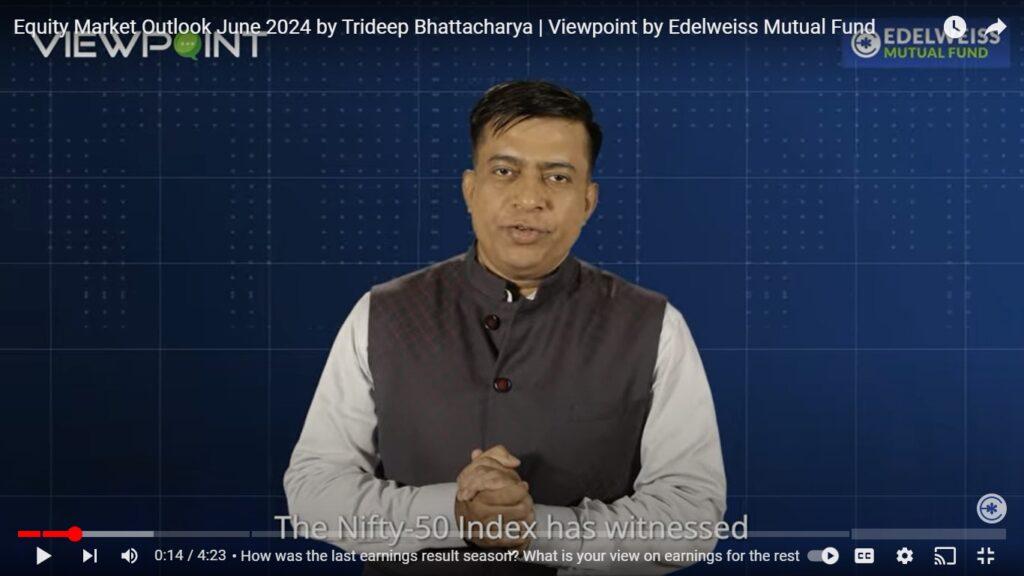
EquityMarket Outlook June 2024 By Trideep Bhattacharya, Edelweiss Mutual fund – released on 24th June 2024

Summary Nifty50 index saw 14% YoY earnings growth in March quarter fi 24. Industrials and capital goods sectors up, while consumer stocks down. Expect transitions in 2024 with manufacturing sectors leading. Key Insights

, , ,

EquityMarket Outlook June 2024 By Trideep Bhattacharya, Edelweiss Mutual fund – released on 24th June 2024 Read Post »