
MarketOutlook

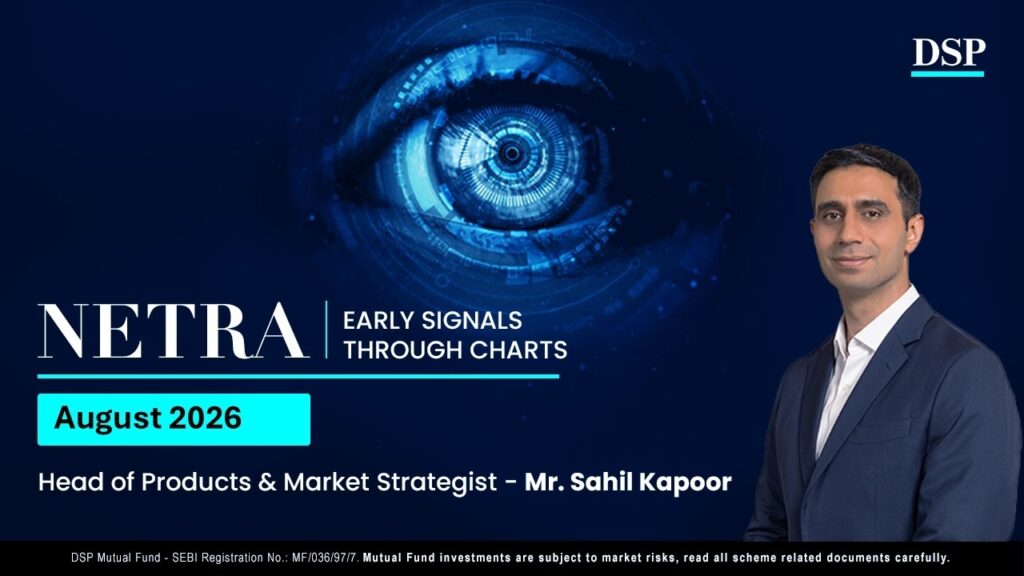
DSP Mutual Fund August 2026 Netra Webinar - FundYantra Fundspeak
Fundspeak

India is the one large market not in the AI trade. That’s now an asset, not a shortcoming

DSP Mutual Fund August 2026 Netra Webinar The DSP Netra August 2026 briefing opens with a sharp reframe: the world is paying record prices for AI capacity it cannot yet monetise. India is the one large market not in that trade — and that is now an asset, not a shortcoming. India’s software-heavy, semiconductor-light composition is a diversification asset right now, not just a hedge against a future reversal. DSP Netra August 2026: the AI concentration risk case This month’s DSP Netra August 2026 briefing comes from Sahil Kapoor, Head of Products & Market Strategist at DSP Mutual Fund. Read alongside the Kotak August outlook — which framed India as the “anti-AI destination if the trade reverses” — and the UTI July non-consensus call. Where Kotak positions India as a hedge, DSP goes further: India’s market composition is a diversification asset right now, and the bargain universe available today didn’t exist in 2024. AI HARDWARE TRADE Fence-Sit INDIA COMPOSITION Diversification Asset BARGAIN UNIVERSE 450–500 Names LT RETURNS Reset to 10–12% Summary The DSP Netra August 2026 call turns on the AI capex concentration risk. Technology now sits at 41% of MSCI ACWI market cap — larger than at the dot-com peak, and the entire move has come from hardware and semiconductors, not software. AI capex is now 2.4–2.7% of US GDP — roughly $1 trillion in 2026 alone — with five hyperscalers having spent $1.3 trillion over five years, more than the world’s largest oil and gas companies since COVID. HBM and memory prices have multiplied 20 to 30 times in a year, which means nominal spend is overstating real capacity creation. The return math doesn’t work yet: a $2–3 trillion cumulative capex programme needs $3–4 trillion of annual revenue to justify itself, while global IT spend after 40–50 years is $6 trillion. The gap has to come out of the $45 trillion global wage bill — and that isn’t a short exercise. India’s setup is the mirror image. IT services are now just 7.4% of the Nifty — below the global financial crisis low of 8.8%. Nifty price-to-book is below its long-term average with ROEs materially higher than at the December 2020 lows. Out of the BSE 1400-plus universe, 450 to 500 companies now screen as bargains with sub-20-times multiples available across financials, IT, select healthcare, auto and insurance — a set that simply did not exist in 2024. Two flat years have delivered a time correction, not a price correction. DSP’s calls: fence-sit on the AI hardware trade; own India as a diversification asset now; reset long-term return expectations to 10–12% before costs; and hunt the bargain universe. The detail The AI concentration risk — 41% of MSCI ACWI, larger than the dot-com peak Technology, counting IT and communication services together, is now 41% of MSCI ACWI market cap — larger than at the dot-com peak. And within it, the entire move has come from hardware and semiconductors, not software. A large part of the reported capex is price, not capacity. Some HBM and memory prices have multiplied 20 to 30 times in a year. GPU rental pricing and the semiconductor producer price index have both moved sharply higher, which means nominal spend is overstating real capacity creation. Funding is increasingly moving from cash flow to debt — having been almost entirely cash-flow-funded until recently. And China is undercutting on price with open-weight models while adding grid capacity in a single year equal to all of Germany’s — which puts the incumbents’ revenue visibility, and therefore their funding, at risk. The return math — the cascade that doesn’t compute yet Every $1 of infrastructure capex becomes $1.5 at the compute layer, $2.7 at the model layer and $4 at the end user. So a $2 to $3 trillion cumulative capex programme needs $3 to $4 trillion of annual revenue to justify itself. Global IT spend, after forty to fifty years, is $6 trillion. The gap has to come out of the $45 trillion global wage bill. That is the unanswered question — and it doesn’t get answered in a quarter. Business investment in computer and peripheral equipment in the US is growing 75% year on year; globally the number is close to $600 billion and approaching the dot-com peak as a share of GDP. That is roughly five to six years of normal demand bought in two years. Why India sits outside — IT at 7.4% of the Nifty, below the GFC low India sits outside the AI hardware trade almost entirely. IT services are now just 7.4% of the Nifty — below the global financial crisis low of 8.8%. That composition, until recently framed as a lack of exposure, is now the setup. All of MSCI EM’s return this year has come from technology, and within technology from semis and hardware. India’s more diversified market composition — software-heavy, semiconductor-light — could become a diversification advantage if the semiconductor and hardware trade normalises. Indian valuations have quietly reset. Nifty price-to-book is below its long-term average on both trailing and forward, at levels last seen in December 2020 but with materially higher ROEs. The same price, better quality. The bargain universe — 450 to 500 names that didn’t exist in 2024 Out of the BSE 1400-plus universe, 450 to 500 companies now screen as bargains, with sub-20-times multiples available across financials, IT, select healthcare, auto and insurance. That is a large enough set to build a genuinely better-quality portfolio — a set that simply did not exist in 2024. Two flat years have delivered a time correction rather than a price correction. The Nifty has spent over 103 days below its 200-day average with modest drawdowns — which is exactly the starting point that improves forward returns. Reset long-term returns to 10–12% before costs — the honest math Reset long-term return expectations to 10 to 12% before costs. Domestic sales growth tracks nominal GDP at 10 to 12%. Export growth lands at 7 to 11% including currency. Margins

India is the one large market not in the AI trade. That’s now an asset, not a shortcoming Read Post »

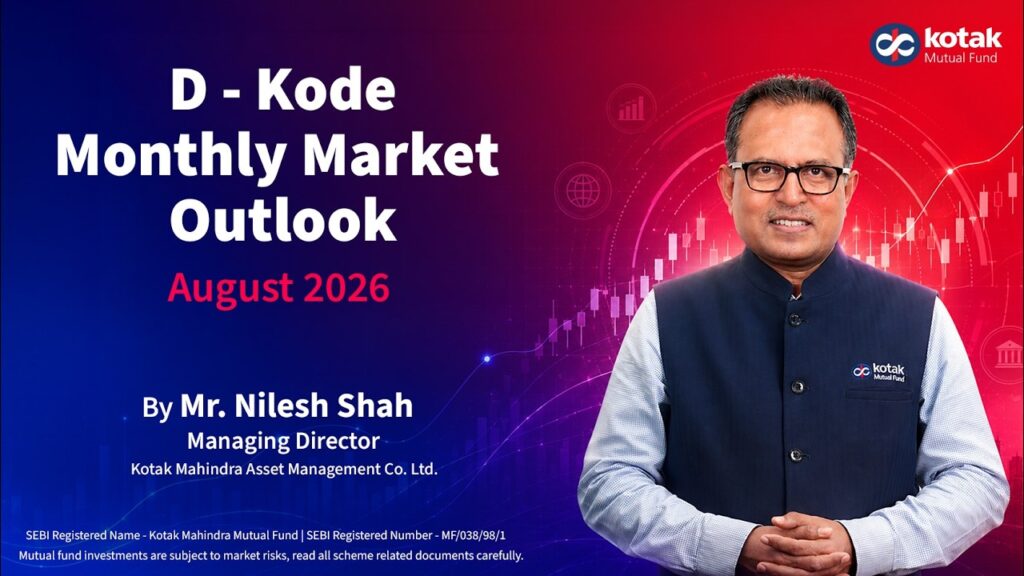
Kotak Mutual Fund August 2026 Market Outlook Webinar - FundYantra Fundspeak
Fundspeak

The setup has changed — IPO supply is the new ceiling

Kotak Mutual Fund August 2026 Market Outlook The Kotak market outlook August 2026 delivers a specific reframe: FPI ownership of Indian equities is at a decadal low, FPIs turned buyers in July, and earnings are beating across every market-cap bucket. The setup has changed — what caps the upside now is IPO supply, not fundamentals. Kotak market outlook August 2026: the setup has changed This month’s Kotak market outlook August 2026 briefing comes from Nilesh Shah, MD & CEO of Kotak Mutual Fund, alongside the equity and fixed income teams. Read alongside the Kotak July outlook — where the call was “diversify, don’t react” — and the UTI July non-consensus call that flagged US-dollar peaks. This month, Kotak turns constructive: get invested, but stagger it. FPI OWNERSHIP Decadal Low EARNINGS Beating All Buckets MID-CAPS Overweight ENTRY Stagger, Don’t Lump Summary The Kotak market outlook August 2026 lands on a constructive but disciplined call. FPI ownership of Indian equities is at a decadal low, FPIs sold through March–June but turned buyers in July, and the June-quarter earnings beat was broad: 13 Nifty 50 companies beat versus 6 misses, 17 of Nifty Next 50 beat versus 3, and 18 mid-caps beat versus 12. MSCI India earnings grew around 10% in FY26 with FY27 and FY28 both tracking double digits. What caps the upside now, in Kotak’s read, is IPO supply — not fundamentals. The risks are specific and named: monsoon (June at 40% deficit, July nearly normal but a super El Niño expected through August–September), fiscal pressure (personal income tax growth at a decadal low, capex stagnant), a rupee near an all-time low with the RBI over $100 billion short in the forward market, and globally, US hyperscaler free cash flow turning negative with ~$1.65 trillion of AI-related debt sitting off balance sheet as committed leases. The framework: get invested, but stagger it. Two–three instalments if underweight; six–nine spread over three months if equal-weight. Mid-cap overweight, large-cap equal-weight, small-cap marginally underweight. Financials are the anchor, discretionary consumption over staples, IT neutral, gold positive, and if the AI trade reverses — India sits at the top of the anti-AI list. The detail The setup — FPI ownership at decadal low, earnings beating across buckets FPIs sold through March to June and turned buyers in July, with FPI ownership of Indian equities now at a decadal low. On a Nifty-versus-global-indices basis, this kind of divergence is historically where Indian markets bottom out and start outperforming. Corporate earnings have beaten across the board in the June quarter: 13 Nifty 50 companies beat versus 6 misses, 17 of the Nifty Next 50 beat versus 3, and 18 mid-caps beat versus 12. MSCI India Index earnings grew around 10% in FY26; FY27 and FY28 are both tracking double digits. Valuations are reasonable — large-caps around historical average, large-mids at a 10% premium, small caps at about 20% premium. Government and RBI have moved hard on flows: ECB norms liberalised, roughly $37–40 billion mobilised under FCNR-B, tax exemption for debt FPIs, and roughly $100 billion expected between June and December 2026 — enough to cover the RBI’s forward position and restore some respectability to the rupee. Services exports at ~$400 billion with a $200 billion-plus surplus; GCCs offset the IT services drag; defence exports have climbed to ₹38,000 crore. RBI has revised core inflation down to about 4.3% and GDP growth up. The risks — monsoon, fiscal pressure, rupee, retail credit shift Monsoon is the live one. June came in at a 40% deficit, July was almost normal and pulled the season deficiency down to 13%, but a super El Niño is expected through August and September — a positive Indian Ocean Dipole is the only offset in sight. Agriculture is under 15% of GDP but employs a far larger share of the workforce, and once the monsoon deficit goes beyond 10%, the hit to agriculture GDP and the rural economy is substantial. Fiscally: personal income tax collection growth has slowed to a decadal low, government spending is the lowest in a decade, and central government capex has stagnated from FY26 and is likely to stay flat in FY27 — with the Middle East situation and a potential 8th Pay Commission pushing the deficit above budget. The rupee is near an all-time low, with the RBI over $100 billion short in the forward market and Chinese imports keeping the goods trade deficit high. A shift in retail credit worth watching: consumption loans not taken for a vehicle or a home are now roughly half of all outstanding retail credit, up from 34% in March 2017. That is a leverage build in the household balance sheet, not a growth story. Global — AI credit stress and the “anti-AI destination” case US hyperscalers have turned free cash flow negative. Their borrowing is going from under $20 billion in 2023–24 to about $200 billion in 2026. Credit spreads have widened across the group. And roughly $1.65 trillion of AI-related debt sits off balance sheet as committed leases. Kotak’s read: if the AI trade reverses, money looks for an anti-AI destination — and India sits at the top of that list. That is the case for hoping this time brings a decoupling between US and Indian markets. Cap-size positioning — Mid OW, Large EW, Small UW Mid-cap overweight, large-cap equal weight, small-cap marginally underweight. Earnings have delivered across all buckets, but the valuation math tilts positioning toward mid-caps. Small caps are already about 20% above historical average valuations and are up 15% from pre-crisis levels while large caps are still 4% below February. The value has moved unevenly — Kotak wants exposure to the segment where earnings and valuation align, and steps back from the segment that has already run. Sector calls — Financials anchor, discretionary consumption, IT neutral, infra over oil Financials remain the anchor. Credit growth healthy, retail participation returning, margins holding despite cost pressure, credit costs better than expected. Prefer private banks over PSUs, and mid-size private banks

The setup has changed — IPO supply is the new ceiling Read Post »

Fundspeak

Fade the dollar, own the rupee — UTI’s July non-consensus call

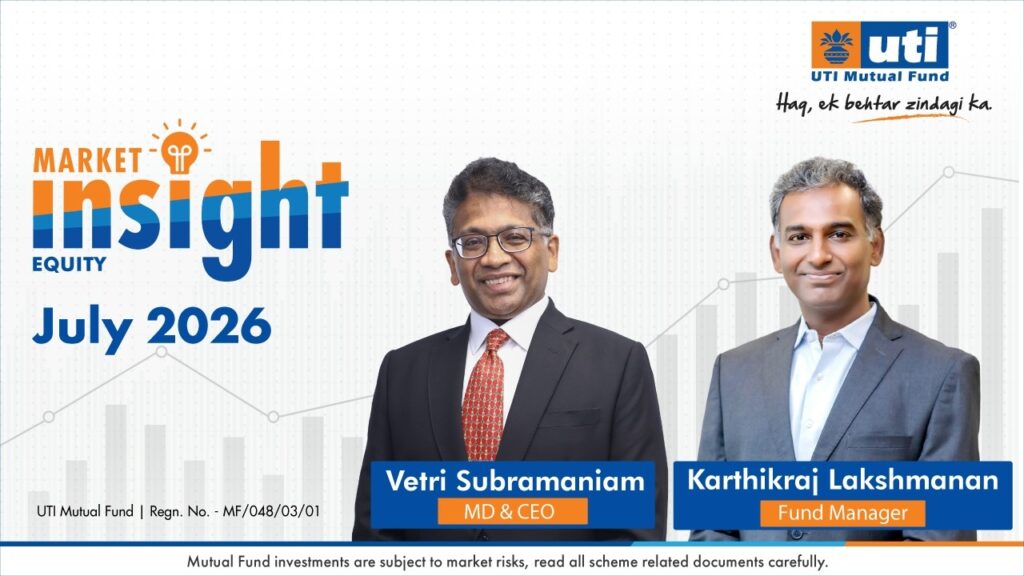
UTI Mutual Fund July 2026 Equity Markets The UTI equity market July 2026 briefing opens with a sharp contrarian line: the consensus trade is long US, long dollar — and that may be exactly the wrong bet right now. UTI’s non-consensus call: be cautious on US equities and the dollar, positive on rupee assets, and lean into large-cap India with private banks as the highest-conviction position. UTI equity market July 2026: the non-consensus setup This month’s UTI equity market July 2026 briefing comes from Vetri Subramanyam, MD & CEO of UTI Mutual Fund. Read alongside the Kotak July outlook, the DSP July outlook and the Motilal Oswal July outlook, a converging AMC view emerges on Indian large-caps, private banks, and the case against the crowded US-dollar trade. US EQUITIES & DOLLAR Near a Peak INDIA LARGE-CAP Increase Allocation PRIVATE BANKS Highest Conviction RUPEE Undervalued · REER 90.8 Summary The UTI equity market July 2026 view is built on a non-consensus reading: US equities now absorb 65% of global equity benchmarks, MAG 7 hyperscalers are underperforming the S&P 500 as markets question ROI on AI capex, and the new Fed chair prefers rate hikes and less forward guidance — more volatility, higher term premiums. Fiscal indiscipline plus inflation above target makes US equities and the dollar look near a peak. The India setup is the mirror image. UTI’s proprietary equity valuation index has moved into the ‘increase equity allocation’ zone after two years of going nowhere — historically delivering a 14% average one-year return, negative only 7% of the time. INR REER at 90.8 vs a long-term fair value of 101.7 makes rupee assets structurally attractive. FY27 Nifty earnings growth expected at 14%, with 62% of Nifty 500 companies already growing revenue above 10%. Private banks are the highest-conviction call — below historical valuations, asset quality at multi-decade lows, structural compounders for three decades. That triple rarely appears together. The detail The US concentration problem — and the new Fed US equities now account for 65% of global equity benchmarks, absorbing capital that would otherwise flow elsewhere. The new Fed chair prefers rate hikes over balance sheet tools and less forward guidance — a mix that translates directly into more volatility and higher term premiums. MAG 7 hyperscalers are now underperforming the S&P 500 as markets begin to question ROI on AI capex. The internal composition of the US market is shifting even before the broader index moves. The India setup — valuation index in ‘increase’ zone UTI’s proprietary equity valuation index has moved into the increase equity allocation zone after two years of going nowhere. Historically, this signal has delivered a 14% average one-year return, negative only 7% of the time. Large-cap is close to cheap on price-to-book with ROE at the upper end of its historical range. Mid and small-cap, by contrast, sit in the expensive zone on price-to-book relative to history — the mean-reversion trade at the top of the cap curve hasn’t played out yet, but the case remains intact. FY27 Nifty earnings growth is expected at 14%, with 62% of Nifty 500 companies already growing revenue above 10%. Broad earnings support beneath a fairly-valued index. The rupee call — REER at 90.8 vs 101.7 fair value INR real effective exchange rate (REER) is at 90.8 versus a long-term fair value of 101.7 — the rupee is significantly undervalued. UTI’s framing: “We’d rather be positive on rupee versus dollar than the other way around.” The dollar trade is crowded; the rupee case has room. When mean-reversion happens in currency, rupee-denominated Indian equities benefit twice — through fundamentals and through the currency translation. Private banks — the rare triple, again Private banks are the highest-conviction call within Indian equities. They sit below long-term average valuations, with asset quality at multi-decade lows, and represent structural compounders for three decades. That triple — low valuations, historic-best asset quality, structural growth advantage — rarely appears together. It’s now the fourth AMC after Kotak, DSP, and ICICI Prudential to flag private banks as the highest-conviction Indian equity call this quarter. AI — the trade has already rotated The easy part of the AI trade is behind us. Picks-and-shovels suppliers — memory chips, semiconductors — are up 101% year-to-date, while hyperscalers are up just 1.74%. The market has moved the money from the platforms to the infrastructure that enables them. Anyone assuming the AI trade is still concentrated in the MAG 7 is looking at the wrong screen. On monsoon — not a portfolio call Historical data shows no clear pattern linking monsoon outcomes with equity markets or GDP growth. It’s a headline risk to be aware of, but not a positioning call in the portfolio. Where other AMCs this month have flagged monsoon as a near-term risk, UTI is clear: the data doesn’t support treating it as a portfolio input. What this means for investors The takeaway Fade the consensus trade, own the mean-reversion at both ends — Indian large-cap and the rupee. The AI easy money is behind us; the private-bank triple is still in front: Fade the consensus: US equities and the dollar. Fiscal indiscipline, inflation above target, and a new Fed adding uncertainty. Both appear near a peak — reduce exposure rather than add. Increase Indian large-cap allocation. UTI’s valuation index is in the ‘increase’ zone — historically 14% average one-year return, negative only 7% of the time. Cheap price-to-book with ROE at the upper end of the range. Own the private-bank triple. Below long-term valuations, multi-decade-low NPAs, three-decade structural compounders. Fourth AMC this quarter to flag it as highest conviction — worth listening. Position for a rupee mean-reversion. INR REER at 90.8 vs 101.7 fair value — rupee significantly undervalued. Prefer rupee assets over dollar exposure while the gap remains this wide. The easy AI money is behind us. Picks-and-shovels (chips, semis) up 101% YTD vs hyperscalers up 1.74%. Don’t assume the AI trade is still where headlines say it is — the money has already rotated.

, , , , , , , , ,

Fade the dollar, own the rupee — UTI’s July non-consensus call Read Post »

Fundspeak

18.45% more gold, same asset: Kotak’s LRS arbitrage and the rest of the July call

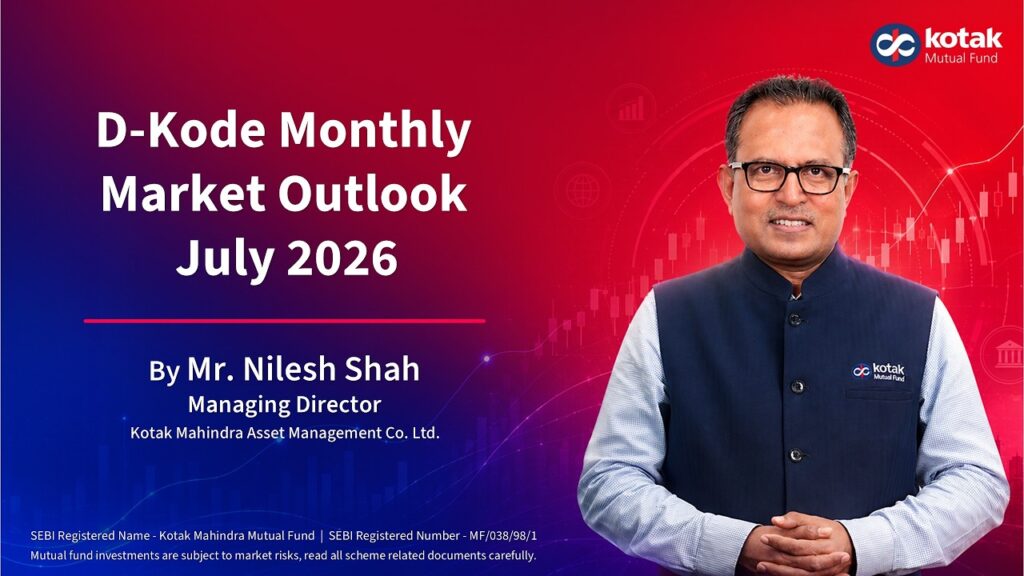
Kotak Mutual Fund July 2026 Market Outlook The Kotak market outlook July 2026 makes a simple case: India’s equity market is at fair value in aggregate — but the opportunity is in the dispersion, not the index. Kotak’s call: overweight mid-caps for the earnings edge, private banks as the highest conviction position, and gold with a specific 18.45% LRS arbitrage. Kotak market outlook July 2026: what changed this month This month’s Kotak market outlook July 2026 briefing from Nilesh Shah, MD & CEO of Kotak Mahindra Mutual Fund, distils three concrete calls: mid-caps for the earnings edge, private banks as the highest-conviction position, and a specific 18.45% gold LRS arbitrage. Read alongside the DSP July outlook and the Motilal Oswal July outlook, a converging AMC view on Indian large-caps and private banks becomes visible. NIFTY VALUATION 18.4 PE · Fair Value MID-CAPS Overweight PRIVATE BANKS Highest Conviction GOLD Own It Summary Kotak reads the Nifty at 18.4 PE versus a historical average of 18.7 — effectively fair value. The trade, then, is dispersion inside the index, not the index itself. The Kotak market outlook July 2026 is straightforward on positioning: mid-caps overweight on a 16–18% expected FY27 earnings edge over large-cap’s 10–11%, and private banks as the highest-conviction call — low valuations, 17% credit growth, NPAs at historical lows, rate cut cycle bottoming — a triple that rarely appears together. Gold gets a specific action: 45% of central banks plan to increase holdings per the WGC survey; resident Indians can access 18.45% more gold via LRS global ETFs by avoiding 15% import duty and 3.45% GST. In debt, the RBI has signalled no rate hikes; Income Plus Arbitrage is recommended for conservative investors with a 2-year-plus horizon, with the 10-year G-Sec range expected at 6.60–6.80%. Near-term risks: a monsoon 40% below normal in June and roughly ₹4.3 lakh crore of fiscal war-shock pressure. The detail The setup — fair value at the index, dispersion inside it Large-cap Nifty PE sits at 18.4 versus a historical average of 18.7 — effectively at fair value. That means the index itself doesn’t offer a compelling entry, but the segments below it do. Kotak’s framing is straightforward: don’t buy the index, buy the dispersion within it. The rupee on a real effective exchange rate (REER) basis is now below the Chinese Yuan for the first time since April 2023 — a structural export tailwind that supports the broader equity thesis. Near-term risks — monsoon and fiscal war-shock Monsoon is the most immediate concern. June came in 40% below normal, with central India at a 59% deficit. El Niño is expected to intensify through August and September. The fiscal war-shock adds up to roughly ₹4.3 lakh crore in pressure across excise cuts, fertilizer and LPG subsidies, and tax shortfalls — manageable but real. FPI return is still a slow burn: EM and Asia-dedicated funds remain structurally underweight India. The flow story — BOP surplus and FPI stabilisation A BOP surplus is expected in FY27 after a two-year gap — $50–75 billion in FCNR, ECB and FPI debt flows coming over the next 3–6 months. FPI selling intensity has come down and occasional buying has started. The set-up isn’t a flow explosion — it’s a flow stabilisation. Enough to change the pressure on the currency and shift the perception of India’s external position, without needing a full FII reversal to work. Cap-size calls — mid-caps overweight, small-caps trimmed Mid-cap overweight on earnings conviction — 16–18% growth expected for FY27 versus 10–11% for large-cap justifies the selective premium. Large-cap equal weight. Valuations are at the historical average and earnings growth is moderate — no reason to overweight, no reason to underweight. Small-cap marginally underweight. The monsoon and Q1 oil impact are more likely to show up here first than in more diversified segments. Sector picks — private banks the conviction, IT selective Private banks are the highest-conviction call. Low valuations, strong earnings (credit growth at 17%), NPAs at historical lows, and the rate-cut cycle bottoming — a triple that rarely appears together. IT: equal weight to slightly underweight. Valuations are attractive (15–20x PE, dividend yield 5–6%), but large-cap IT can only realistically deliver 3–6% dollar revenue growth. Prefer mid-cap IT for market-share gains. Gold — own it, and there’s a specific arbitrage Own gold. 45% of central banks plan to increase holdings per the World Gold Council survey. When central banks buy, you buy. The specific trade for resident Indians: access 18.45% more gold via LRS global ETFs by avoiding 15% import duty and 3.45% GST. Same asset, materially better entry. Fixed income — no hikes signalled, Income Plus Arbitrage the pick The RBI has signalled no rate hikes. The 10-year G-Sec range is expected at 6.60–6.80%. Income Plus Arbitrage is recommended for conservative investors with a 2-year-plus horizon — combining the short-term-fund experience on the debt leg with the tax-efficient arbitrage sleeve for a cleaner after-tax outcome. What this means for investors The takeaway Own the dispersion, not the index. Kotak’s setup translates into specific positions across cap sizes, sectors, and asset classes: Overweight mid-caps for the earnings edge. 16–18% expected FY27 earnings growth versus 10–11% for large-cap — enough to justify a selective premium. The index is at fair value; mid-cap earnings aren’t. Highest conviction: private banks. Low valuations, 17% credit growth, historically-low NPAs, and the rate-cut cycle bottoming — a rare four-way alignment. Position for it while it holds. Own gold — and use the LRS arbitrage. Central banks are buying (45% plan to increase per WGC). Resident Indians can access 18.45% more gold via LRS global ETFs by avoiding 15% import duty + 3.45% GST. Same asset, better entry. Trim small-caps; be selective on IT. Small-caps take the monsoon and Q1 oil impact first. Large-cap IT can only deliver 3–6% dollar revenue growth — prefer mid-cap IT for market-share gains. In debt: Income Plus Arbitrage for 2+ year horizons. RBI has signalled no rate hikes; 10-year G-Sec range expected at 6.60–6.80%. Income

18.45% more gold, same asset: Kotak’s LRS arbitrage and the rest of the July call Read Post »

Fundspeak

Buy rupee assets: DSP’s July call at both ends of the risk spectrum

DSP Mutual Fund July 2026 Netra Webinar The DSP market outlook July 2026 opens with a simple line: the stress narrative on India was built at exactly the wrong time. The macro has already turned. Buy rupee assets — large-cap equities and duration bonds are the two clearest expressions of the call. And within equities, private banks look like a rare triple. DSP market outlook July 2026: the mean-reversion setup This month’s DSP market outlook July 2026 comes from Sahil Kapoor, Head of Products & Market Strategist at DSP Mutual Fund. Read alongside the Kotak July outlook and the Motilal Oswal July outlook, a converging AMC view emerges: private banks as the highest-conviction Indian equity call, and India itself as the natural mean-reversion trade within EM. RUPEE ASSETS Buy LARGE-CAP SHARE Record Low 17% DURATION Own It IT · GOLD · SILVER Wait / Neutral Summary The DSP market outlook July 2026 argues the India-stress narrative was built at exactly the wrong time. In 30 days, oil moved from projections of a $220 billion trade deficit to $68–70, the NRI deposit scheme brought $6 billion in FPI debt inflows in a single month, and the India–US inflation differential collapsed from 4% to 50 basis points. Large-cap market cap share sits at a record-low 17%, with two-thirds of FII selling concentrated in the top 10 stocks — all now trading below their 10-year average multiples while ROE remains high. The two clearest expressions of the call: large-cap equities and duration bonds. Within equities, private banks are the rare triple — low valuations, 12–20% earnings growth, NPAs at historical lows. In debt, real rates at 2.5% versus an RBI target of 100 bps give duration a dual path — RBI cuts, or growth disappoints. Either works. IT: watch, don’t act. Gold and silver: neutral, not overweight. The detail The 30-day macro reversal — narrative vs data On 1st June 2026, India’s balance of payments looked precarious — oil trade deficit projected at $220 billion, FPI outflows at $16 billion for the year, rupee under pressure. Thirty days later, oil is at $68–70, the NRI deposit scheme has brought in $6 billion in FPI debt inflows in a month, and the rupee real effective exchange rate has hit a level seen only twice this century — GFC and 2013. The India–US inflation differential that underpins the structural rupee-depreciation call has collapsed from 4% to 50 basis points. The narrative hasn’t caught up with the data yet. Buy rupee assets — the setup in large-caps Large-cap market cap share has dropped to a record low of 17%, with two-thirds of all FII selling concentrated in the top 10 stocks — all of which are now trading below their 10-year average multiples while ROE remains high. The setup is straightforward: the segment most sold by foreign capital is also the segment where fundamentals have held. That’s the mean-reversion trade at the top of the market cap curve. Private banks — a rare triple Within large-caps, private banks stand out. They present a rare triple: low valuations, earnings growth of 12–20%, and NPAs at historical lows. This combination rarely appears together. Historically, low valuations usually come with weak earnings or credit concerns. Getting all three at once is unusual — and worth positioning for. Sector calls — cement in, IT wait Cement is a clean proxy for construction and infrastructure activity. Margins are at cyclical lows, input costs are falling, and government capex is picking up as we enter the second half of the political term. IT: watch, not act. The valuation case is there — PE below 14x versus a 10-year average of 18–19x, and FCF yield near 7%. But the growth case is not settled. GCC market share gains, AI disruption still in narrative but not yet in numbers, and headcount stagnation since FY22 are structural, not cyclical. Wait for the growth signal before adding. Duration — the dual path in debt In debt, duration makes sense — either RBI cuts and bonds rally, or growth disappoints and rates fall on their own. Both paths favour duration. Real rates are running at 2.5% against an RBI historical target of 100 basis points — among the highest in emerging markets. That’s structural room for rates to move lower, regardless of the trigger. India as the EM mean-reversion trade India after 18 months of underperformance is the natural mean-reversion trade within EM as Korea and Taiwan concentration reaches dot-com era price-to-book levels. Concentration at that level, historically, does not end well. When it unwinds, the capital tends to look for the cheapest-with-fundamentals story left standing. India, on DSP’s read, is that story. Gold and silver — neutral, not overweight Gold and silver: neutral, not overweight. DSP’s five-point framework shows only one of five conditions close to being met. Jewelry, central bank, and ETF demand drivers are all sideways or falling — making a quick return to January 2026 highs unlikely. The froth from January 2026 is gone, but the case for a large overweight is not yet there. What this means for investors The takeaway Buy the mean-reversion trade at both ends of the risk spectrum — large-caps for equity, duration for debt. Skip the sectors where the narrative is louder than the numbers: Buy rupee assets — large-caps and duration. The two clearest expressions of the mean-reversion call. Large-caps at record-low market cap share with intact ROE; duration with a dual path (RBI cut or growth disappoint — both work). Own the rare triple in private banks. Low valuations + 12–20% earnings growth + NPAs at historical lows. This combination rarely appears together — worth positioning for while it’s there. Add cement for the capex cycle. Cyclical-low margins, falling input costs, and government capex picking up in the second half of the political term. A clean proxy for construction and infra activity. Own duration in debt. Real rates at 2.5% versus an RBI target of 100 bps give structural room to move lower. Duration

Buy rupee assets: DSP’s July call at both ends of the risk spectrum Read Post »

Fundspeak

Liquidity, not rate cuts: UTI’s July fixed income call is different from the consensus

UTI Mutual Fund July 2026 Fixed Income The war-peak stress on Indian fixed income has reversed faster than expected. The question now is where on the curve to be — and the answer isn’t where the consensus is going. It’s a liquidity call, not a rate-cut call. FRONT-TO-MIDDLE Overweight DURATION Underweight LIQUIDITY INFLOW ₹5 Lakh Cr FED MARKET READ Overhawkish Summary The war-peak stress on Indian fixed income has unwound quickly — rate hike expectations have been cut from 100–150 bps to 50–75, inflation from 5–5.5% to 4.5–5%, the INR has stabilised, and the current account deficit is shrinking. UTI’s call: own the front-to-middle of the curve (1–5 year) — money market, low duration, short-term and corporate bond funds. The reason isn’t a rate-cut thesis. It’s a liquidity thesis: roughly ₹5 lakh crores of FCNR and ECB inflows over the next three months will reduce banks’ need to issue high-cost CDs, compress the short end, and benefit the 1–5 year segment directly. Don’t chase duration — oil moving from $70 to $78 in 3–4 days shows why. On the Fed, UTI thinks the market is over-reading Kevin Walsh as hawkish. The detail The macro reversal — from war-peak stress to a working setup The macro picture has reversed sharply from war-peak stress. Rate hike expectations have been cut from 100–150 basis points to 50–75. Inflation expectations have come down from 5–5.5% to 4.5–5%. The INR has stabilised. The current account deficit is shrinking as oil normalises at $70–75. More importantly, the removal of withholding tax and capital gains tax for foreign investors on Indian bonds has opened the pathway to Bloomberg Global Aggregate Index inclusion — which, if it happens, brings in structural all-weather flows rather than cyclical EM money. The liquidity windfall — ₹5 lakh crores incoming A liquidity windfall is coming. FCNR inflows and offshore borrowing by state-owned entities are expected to bring roughly ₹5 lakh crores into the banking system over the next 3 months — far more than was anticipated at the start of the year. This is the anchor of UTI’s positioning: liquidity of this size doesn’t need a rate cut to work through the curve. It reshapes bank funding needs directly. Why front-to-middle wins — a liquidity call, not a rate-cut call The front-to-middle of the curve — money market, low duration, short-term and corporate bond funds — is where the opportunity sits right now, and for a specific reason: the incoming FCNR and ECB liquidity will reduce banks’ need to issue high-cost CDs, compress the short end, and benefit the 1–5 year segment directly. This is a liquidity-driven call, not a rate-cut call — and it’s more durable for that reason. It doesn’t require a specific RBI decision to work. Why the long end still isn’t safe Don’t chase duration yet. UTI stayed underweight duration even when the 10-year fell from 7.10 to 6.75 — and oil moving back to $78 in days shows why. Oil remains volatile — it moved from $70 to $78 in just 3–4 days even after the ceasefire, which means the long end of the curve could spike again if geopolitics flare up. Monsoon so far has been the fifth weakest June since 1901, with actual rainfall 40% below IMD’s forecast of 8% below normal — a seasonal inflation spike of 3–4 months is likely before winter arrivals bring relief. Wait for more conviction on oil before extending duration meaningfully. On the Fed — the market is assuming the worst The new Fed chair Kevin Walsh is being read by the market as unambiguously hawkish, pushing out rate cut expectations. UTI’s view: the market is assuming the worst from Walsh’s task forces. AI adoption is long-term disinflationary — productivity gains take time but they are real — and the committee recommendations are more likely to be balanced than the market currently prices. Rate cut expectations being pushed out may itself get repriced when the task force recommendations come back more balanced than feared. Portfolio expressions by horizon For investors with more than 2 years: income plus arbitrage offers a favourable combination — short-term fund experience on 65% of the portfolio, stable arbitrage on 35%, and tax treatment at 12.5% rather than marginal rate. For investors with 3–12 months: money market and low duration funds are the cleaner expression of the liquidity tailwind. What this means for investors The takeaway Own the front-to-middle for a specific, mechanical reason — the ₹5 lakh crore liquidity working through the banking system. Don’t reach for duration just because the war-peak has passed: Own the front-to-middle of the curve. Money market, low duration, short-term and corporate bond funds — the 1–5 year segment benefits directly from incoming FCNR and ECB liquidity compressing the short end. Don’t chase duration yet. The 10-year has already fallen from 7.10 to 6.75, and oil moving back to $78 in days shows the long end is still exposed. Wait for more conviction on oil before extending duration. Horizon > 2 years: consider income + arbitrage. A 65/35 split — short-term fund experience on 65%, stable arbitrage on 35% — with 12.5% tax treatment rather than marginal rate. A favourable combination for the mid-horizon investor. Horizon 3–12 months: money market and low duration. The cleanest way to express the liquidity tailwind — short enough to sidestep duration risk, long enough to capture the compression benefit. Don’t over-price the Fed hawk story. The market is assuming the worst from Walsh. If task force recommendations come back balanced, rate-cut expectations get repriced — a risk to the market’s current positioning, not to UTI’s. Fixed Income UTI Mutual Fund Short Duration Liquidity Windfall FCNR & ECB Yield Curve Bloomberg Index Inclusion July 2026 Mutual fund investments are subject to market risks. Please read all scheme-related documents carefully. The views expressed are those of the speaker and do not constitute investment advice.
Liquidity, not rate cuts: UTI’s July fixed income call is different from the consensus Read Post »

Fundspeak

Indian equities at a 10-year low premium — and earnings kept growing through it

Motilal Oswal Mutual Fund July 2026 Monthly Market Outlook The Motilal Oswal market outlook July 2026 opens with a striking data point: Indian equities at a 10-year low premium to emerging markets — and earnings kept growing through it. That’s the setup. Oil is the unlock. While you wait for it, it’s time for alpha over beta. Motilal Oswal market outlook July 2026: the setup and the wait This month’s Motilal Oswal market outlook July 2026 briefing comes from Prateek Agrawal, CIO of Motilal Oswal Mutual Fund. Read alongside the Kotak July outlook and the DSP July outlook, a converging AMC view emerges on Indian large-caps at derated valuations while earnings compound. EM VALUATION PREMIUM 10-Year Low CRUDE Below $80 INR Stabilising STRATEGY Alpha over Beta Summary The Motilal Oswal market outlook July 2026 sits on a striking observation: Indian equities have been among the worst-performing asset classes over the past 18 months — not because earnings deteriorated (they didn’t), but because of external pressure from INR depreciation, high oil, and sustained FPI selling. The valuation premium to emerging markets is now at a 10-year low. Crude has already retraced below $80, and the NRI deposit scheme is expected to bring strong USD inflows that may have arrested INR depreciation — the very reason FPIs were selling. A drop in oil to February levels could take large-cap indices back to February levels, and from there, earnings do the work. While waiting for that unlock, Motilal Oswal’s framework is alpha over beta — value migration into spaces where growth is high and sustains longer: EVs, defense, renewables and BESS, and power and data centres riding AI demand. The detail The setup — earnings held, prices didn’t Indian equities have been among the worst-performing asset classes over the past 18 months — not because earnings deteriorated, they didn’t, but because of external pressure: INR depreciation, high oil, and sustained FPI selling. The result is a valuation premium to emerging markets now at a 10-year low. The setup is a market that’s been derated on flows, not fundamentals. The unlock — oil, INR, and what happens next Crude has already retraced below $80, a sustainable level for an economy like India. The NRI deposit scheme is expected to bring in strong USD inflows — which may have arrested the INR depreciation that was one of the key reasons FPIs were selling. A stable to strengthening INR is a factor foreign investors will re-evaluate Indian assets against. The specific unlock: a drop in oil to February levels may take large-cap indices back to February levels — and from there, earnings do the work. What could delay the unlock The Iran-US agreement still needs to materialize; the Strait of Hormuz remains a risk if it doesn’t. A monsoon shortfall severe enough to hit crops, fertilizer demand and government finances adds another layer of pressure on an already stretched fiscal position. None of these disqualify the thesis. They shape the timing. Alpha over beta — where value is migrating While you wait for the unlock, Motilal Oswal’s view is that it is time for alpha over beta. The framework is value migration — spaces where growth is high and sustains longer. Today that means: EVs over ICE vehicles, defense indigenization, renewables and BESS (battery energy storage systems), and power and data centres riding AI-driven demand. These are the sectors where the migration story is still early enough for growth to compound. What we are avoiding Spaces where the migration story is in its mature or disrupted phase are being avoided: traditional IT, where AI is rewriting the offshoring thesis, and PSU bank share gains, where the movement has slowed. The rule is the same on both sides — own where growth compounds; avoid where the thesis has already played out. A structural tailwind for alpha One structural tailwind being watched: large-caps are raising equity capital this cycle, unlike last year when mid and small caps dominated issuance. A shift in the composition of capital raising may support broader market performance and create a tailwind for alpha — active managers can position for the quality end without giving up growth. What this means for investors The takeaway Own the value migration while you wait for the oil-and-INR unlock — and don’t rely on the index to do the work: Tilt toward alpha, not beta. Passive index exposure captures the derated market, but active management is where the value-migration themes get owned. In this setup, alpha does more of the work than beta. Own the value-migration themes. EVs, defense indigenization, renewables and BESS, power and data centres — the spaces where growth is high and sustains longer than the average sector. Avoid the mature or disrupted stories. Traditional IT is being rewritten by AI; PSU bank share gains have slowed. When the migration is over, so is the alpha. Watch oil, INR, and the Strait of Hormuz. These are the timing variables. The setup is compelling; the trigger for the beta re-rating depends on how they resolve. Stay in the market, not just adjacent to it. The valuation premium is at a 10-year low with earnings intact — that’s a rare setup. Waiting on the sidelines risks missing the re-rating that follows the unlock. The Motilal Oswal market outlook July 2026 lines up alongside a broader converging AMC theme. Both Kotak and DSP flag Indian large-caps as the setup and private banks as the highest-conviction sector call. Motilal Oswal adds the alpha-over-beta framing while everyone waits for the oil unlock. For the underlying regulatory framework governing all three, see the Association of Mutual Funds in India. Equity Motilal Oswal AMC Market Outlook Alpha over Beta Value Migration EVs & Defense Renewables & BESS July 2026 Mutual fund investments are subject to market risks. Please read all scheme-related documents carefully. The views expressed are those of the speaker and do not constitute investment advice.
Indian equities at a 10-year low premium — and earnings kept growing through it Read Post »

Fundspeak

Market Outlook for February 2026 by Mr. Nilesh Shah | Kotak Mutual Fund

Summary Global growth is expected to moderate in 2026 despite rising fiscal deficits across major economies. While central banks have maintained accommodative policies in recent years, their policy flexibility may narrow going forward as debt burdens rise. Rising unemployment, flattening global consumption, and potential unwinding of the yen carry trade present new macro risks. However, India remains among the faster-growing large economies alongside select Asian peers. Domestically, the Union Budget continues the government’s long-term strategy of infrastructure and manufacturing expansion while gradually improving fiscal discipline. Increased capital expenditure and structural policy reforms could support India’s medium-term growth trajectory if execution remains strong. Global Macro Environment Global growth is expected to slow in 2026 relative to both last year and long-term averages, even as fiscal deficits remain elevated. Central banks pursued relatively easy monetary policy during 2024–2025, but their room for further easing may narrow due to growing debt burdens and inflation considerations. At the same time: These factors create a backdrop of elevated market confidence despite weakening macro indicators. Yen Carry Trade Risk Japanese 10-year bond yields have reached multi-decade highs. For decades, Japan served as a major provider of global liquidity through the yen carry trade, where investors borrowed cheaply in yen to invest in higher-yielding assets globally. If rising Japanese yields trigger unwinding of these trades: However, India’s equity and bond markets appear to have limited exposure to yen carry trade flows, suggesting the impact may be relatively modest. China: Growth with Overcapacity China has demonstrated extraordinary industrial expansion, particularly in electric vehicles and power infrastructure. Key highlights: However, rapid capacity creation has led to declining capacity utilization and falling private investment. To counter this slowdown: Despite large-scale economic growth, Chinese equity markets have historically been volatile, experiencing multiple cycles of sharp gains and declines. A potential correction in Chinese markets could redirect capital flows toward India. United States: Growth Driven by AI The US economy has seen strong growth supported by domestic consumption and massive investments in artificial intelligence infrastructure. Technology companies including Amazon, Microsoft, Google, Meta, and Oracle are investing heavily in hyperscale data centers. These investments are estimated to contribute roughly 0.5% incremental GDP growth to the US economy. Since the pandemic: However, this growth has been accompanied by rising debt levels. Rising Debt Risks in the US Debt intensity in the US economy has increased significantly, meaning more borrowing is required to generate the same level of economic output. Key concerns include: Additionally, labour market data has seen repeated downward revisions, with employment figures revised lower by roughly 600,000 jobs over the past year. Income inequality has also widened significantly, with consumption increasingly concentrated among the top 10% of households. Dollar and Global Capital Flows The US dollar index has weakened significantly since early 2025. A weaker dollar, combined with declining US equity market dominance, could trigger global capital reallocation. Notable developments include: These dynamics may encourage global investors to diversify away from US assets. India Budget: Long-Term Structural Focus The Union Budget continued the government’s long-term economic strategy. Earlier budgets focused on: The latest budget increasingly emphasizes the services sector and future industries. Key positives include: Higher capital spending supports long-term productivity and economic growth. Policy Changes and Concerns Some policy measures generated debate: While some tax policies were viewed as inconsistent with earlier expectations, other reforms—including safe harbor provisions for global capability centers and improved buyback taxation rules—were seen as constructive. Execution: The Key Variable The effectiveness of several initiatives depends heavily on execution. Projects such as infrastructure funds, railway corridors, debt market reforms, and infrastructure guarantee schemes will require timely implementation to deliver intended benefits. Historically, certain financial market reforms—such as interest rate futures and credit default swaps—have struggled due to limited market adoption. Indian Economic Outlook The domestic economic outlook remains broadly positive. Government policy has supported consumption by directing financial support across several groups: In addition, the upcoming pay commission could inject roughly ₹3 lakh crore annually into the economy through salary and pension revisions, potentially supporting consumption growth. Risks Key risks to the outlook include: Opportunities India remains structurally well positioned due to: If global investors diversify away from US assets and China faces cyclical corrections, India could benefit from increased capital inflows. FundYantra View The global macro environment is entering a phase of slower growth but higher fiscal expansion, creating potential volatility across asset classes. India’s relative macro stability, improved public investment quality, and structural growth trajectory position it favorably within emerging markets. However, execution of policy initiatives and sustained capital inflows will remain critical determinants of market performance. Mutual fund investments are subject to market risks. Read all scheme-related documents carefully.

, ,

Market Outlook for February 2026 by Mr. Nilesh Shah | Kotak Mutual Fund Read Post »

Fundspeak

Market Outlook for January 2026 by Mr. Nilesh Shah | Kotak Mutual Fund

Summary The global macro landscape entering 2026 is marked by structural shifts rather than cyclical noise. Power is gradually moving from the traditional G7 economies toward emerging blocs, led by China, while global monetary conditions remain accommodative despite elevated debt levels. Equity markets globally have shown resilience, but returns going forward are likely to moderate, making expectations management and asset allocation discipline critical. For India, macro stability remains intact despite pressures from global trade uncertainty, slowing capital inflows, and fiscal constraints. While short-term volatility may persist, India’s contribution to incremental global growth, resilient consumption, and domestic savings continue to provide long-term support. Equity returns are expected to normalize into mid-single to low-double digits, reinforcing the case for balanced portfolios and realistic return expectations. Global Economy A profound structural shift is underway as BRICS economies, led by China, now surpass G7 nations in GDP terms on a purchasing power parity basis. The future trajectory of global markets will be significantly shaped by the evolving US–China relationship. Among the strategic choices available to the US, the current stance appears to lean toward coexistence and division of influence rather than outright confrontation. Globally, debt levels across advanced economies remain elevated at around 130% of GDP. While central banks are expected to continue easing in 2026, the magnitude of rate cuts is likely to be lower than in the previous cycle. Overall monetary conditions remain accommodative across both developed and emerging markets, supporting growth, albeit at levels below the pre-pandemic trend. A key risk emerging from global markets is Japan’s rising bond yields, which raise the possibility of a reversal in yen carry trades, potentially impacting global liquidity and asset prices. Other structural risks include the sustainability of AI-led investments, the durability of disinflation, and the long-term implications of de-dollarization China and United States China continues to rely heavily on manufacturing-led growth, supported by fiscal stimulus and export competitiveness. However, declining capacity utilization, subdued household consumption, and falling manufacturing capex highlight internal imbalances. While Chinese equity markets have rebounded sharply over the last two years, valuations remain anchored near levels seen nearly two decades ago, reflecting persistent structural concerns. In the US, economic growth has surprised positively, driven largely by AI-related capital expenditure. However, this strength comes alongside rising unemployment, elevated debt of nearly $38 trillion, and a weakening dollar. Despite a significant depreciation in the dollar, foreign capital has continued to flow into US assets, creating a divergence from historical patterns. Whether this trend persists remains a key global market question. Indian Economy India’s macroeconomic performance has remained broadly in line with expectations. Government measures, including GST and income tax cuts and labor code implementation, have supported consumption. Industrial production has shown intermittent strength, though momentum remains uneven when averaged over recent months. The key macro challenge lies on the external front. While the trade deficit remains manageable, capital account pressures have intensified due to weak net FDI inflows and sustained remittance outflows. This has resulted in a second consecutive year of balance of payments stress, requiring active intervention by the RBI to manage currency volatility. Fiscal constraints have also become more pronounced. Revenue growth has lagged budgeted targets, forcing higher fiscal deficit utilization and raising the likelihood of expenditure rationalization. Despite these pressures, India remains a key contributor to global growth, accounting for nearly 20% of incremental global GDP growth on a PPP basis. Earnings, Valuations and Market Positioning Equity markets have undergone a meaningful correction, particularly in the small and mid-cap segments, leading to investor discomfort. Foreign investors were net sellers through 2025, driven by India’s relative underperformance versus peers and subdued earnings growth, especially in IT. Valuations across market segments have diverged. Small caps continue to trade at a premium to historical averages, while large and mid-caps are closer to fair value. Market-cap-to-GDP remains elevated, but this is partially offset by profit-to-GDP ratios at all-time highs. Looking ahead, earnings growth is expected to improve from high single digits in 2026 to mid-teens levels thereafter, supported largely by traditional sectors such as energy, utilities, metals, and industrials rather than new-age or AI-heavy investments. Flows and Liquidiy Domestic investors have remained consistent buyers, providing stability amid foreign outflows. FPI ownership has declined to decade-low levels, leaving India under-owned globally. While secondary market selling by active FPIs and private equity players may persist, passive flows could return if capital starts rotating out of US assets. Asset Allocation and Outlook The outlook for 2026 is more constructive than 2025, though volatility from geopolitics, trade negotiations, and global capital flows will remain. Equity return expectations need to be moderated, with high single-digit to low double-digit returns appearing more realistic. Portfolio positioning favors: On the fixed income side, falling inflation and potential global index inclusion of Indian government securities could support bond inflows. Allocation to gold and silver remains relevant, supported by supply constraints, central bank buying, and rising industrial demand. Closing View The investment environment in 2026 is defined less by exuberance and more by realism. Structural global shifts, normalized returns, and selective opportunities argue for disciplined asset allocation and expectation management. While challenges remain, India’s long-term growth relevance, improving earnings visibility, and domestic liquidity support a cautiously optimistic outlook focused on steady compounding rather than aggressive return chasing. Mutual fund investments are subject to market risks. Read all scheme-related documents carefully

, ,

Market Outlook for January 2026 by Mr. Nilesh Shah | Kotak Mutual Fund Read Post »

Fundspeak

Market Outlook for December 2025 by Mr. Nilesh Shah

Summary Fundyantra Market Outlook & Investment Strategy: December 2025 (Based on the outlook shared by Mr. Nilesh Shah, Kotak Mutual Fund) Navigating Global Headwinds and Opportunities The global economic landscape for 2026 is defined by cooling inflation and increasing fiscal expansion, particularly in G7 economies, where debt-to-GDP ratios are rising. As various governments initiate stimulus schemes, money printing is anticipated globally in 2026. While the US Federal Reserve (Fed) is likely to announce rate cuts, the number of further cuts may diminish over the coming years. Global growth is expected to slow slightly from 2025 levels, potentially leading to a marginal increase in inflation due to base effects Key Global Risks for 2026: Investors must monitor the escalating US-China conflict over technology, the ongoing debate regarding whether Artificial Intelligence (AI) represents a bubble or a genuine structural shift, the potential return of inflation driven by fiscal stimulus and rate cuts, and the threat of dedollarization. Furthermore, the rise in the 10-year Japanese bond yield (now around 1.93%) could disrupt the yen carry trade India: Resilience and Moderated Expectations India stands out as the only major economy that has successfully reduced its debt-to-GDP ratio between the subprime crisis and the COVID crisis. The second quarter GDP growth registered a strong 8.2%, propelled by an all-round performance across consumption, investment, and government spending. We project that India’s GDP growth will exceed 7% for FY26 and moderate to between 6% and 6.5% for FY27. The rural economy is also showing strength due to improving rural wages. However, the government is committed to fiscal prudence, meaning private sector investment must step up to maintain momentum, especially as capacity utilisation remains positive at around 75%. The Indian Rupee (INR) has depreciated against many major currencies, helping to increase exports to the rest of the world Equity Market Strategy: Focus on Earnings and Durability The Indian equity index is near all-time highs, but beneath the surface, many small-cap and mid-cap stocks have fallen significantly (15–20% or more) from their 52-week highs. Foreign Portfolio Investors (FPIs) have been net sellers, partly driven by India’s underperformance compared to other emerging markets and single-digit earnings per share (EPS) growth in the Nifty50 over the last six quarters. Conversely, Domestic Institutional Investors (DIIs) remain consistent buyers. Our market valuation, compared to the MSCI Emerging Market average, is now roughly in line with historical premium levels. While large caps trade near their historical average valuation (around 21.5 times), small caps remain significantly above their historical average. The outlook suggests that markets will be rangebound. With limited scope for further valuation rerating, future returns will be primarily driven by earnings growth. We expect earnings growth to rebound in FY27, led by sectors such as telecom, cement, auto, financial services, and chemicals. Opportunities in Fixed Income and Select Equity Sectors While caution is required in broad equities, specific opportunities are emerging: 1. Duration Opportunity in Bonds: The bond market appears attractive. India’s inflation is at a multi-decade low, yet the spread between nominal GDP growth and the 10-year G-sec yield is very narrow. This suggests that interest rates (yields) should be lower than they are currently, creating an opportunity in duration or long bonds (10-year plus maturity) for investors seeking better alignment. 2. Indian IT Sector: The IT sector is currently under-owned, with its weight close to a decade low at 10.2%. Historically, periods of extreme under-ownership precede very strong one-year returns. Furthermore, Nifty IT appears significantly cheaper than NASDAQ (22 times trailing P/E versus 38 times). The sector represents an “underowned, underperforming, and fairly priced bet” when compared to potentially overpriced global tech exposure. Debt and Alternative Assets Debt Market: Despite rate cuts by the RBI, 10-year and 30-year bond yields have moved up. Market participants are confused by the RBI’s communication, particularly regarding Open Market Operations (OMO), which the RBI states are for liquidity management only, not yield signaling. For high-taxpayers, Income and Arbitrage Fund of Funds continue to be a crucial tax-efficient vehicle, with tax rates dropping to 12.5% after two years, significantly lower than potential slab rates up to 39%. Gold and Silver: The outlook for precious metals remains positive, supported by consistent central bank buying (approximately 1,000 tons annually), limited mining opportunities, and global geopolitical uncertainty. Silver prices are supported by demand consistently exceeding supply, primarily driven by industrial uses. However, investors must remember that gold and silver lack intrinsic value (no cash flow or dividend); their value is based purely on perception. Therefore, investment in precious metals should always be a restricted component of a well-diversified portfolio Mutual fund investments are subject to market risks. Read all scheme-related documents carefully

, ,

Market Outlook for December 2025 by Mr. Nilesh Shah Read Post »